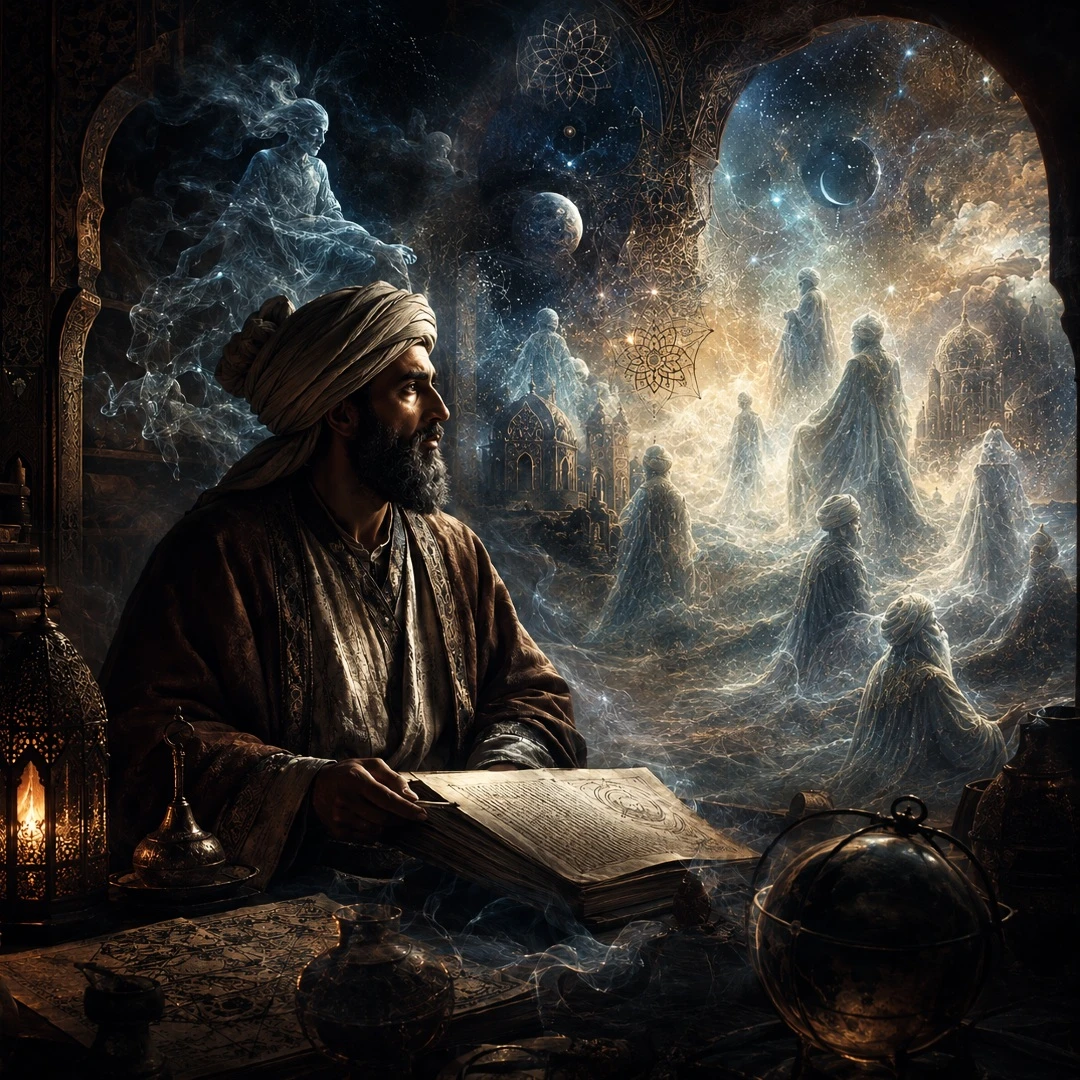
More than eight centuries ago, a man in Andalusia spoke of the unseen world not as a distant idea, but as a realm one could enter, explore, and return from with new knowledge.
That man was Muhyiddin Ibn Arabi, one of the most influential figures in Islamic mysticism. His major works, such as 'The Meccan Revelations' and 'The Bezels of Wisdom,' reveal a world even stranger than their titles suggest: dreams and visions of prophets, encounters with people who had died long before his time, discussions about jinn, a spiritual realm where souls and meanings take form, and journeys into unfamiliar levels of consciousness.
Ibn Arabi didn’t limit himself to personal experiences. He also wrote about the Mahdi and the end times, connecting these themes to what Sufis call 'unveiling' and 'witnessing.'
So what exactly did Ibn Arabi see? Did he consider these visions to be mere dreams, or genuine contact with the unseen world?
A Man Between Two Worlds
Muhammad ibn Ali ibn Arabi was born in Murcia, Andalusia in 1165. He traveled throughout Andalusia, Morocco, Mecca, Anatolia, and the Levant, eventually settling in Damascus, where he died in 1240. 'Muhyiddin' is an honorific by which he became so well known that specialized sources simply refer to him as 'Muhyiddin Ibn Arabi.' His mystical journey was not just an intellectual pursuit; much of it was rooted in what Sufis call 'unveiling' and 'witnessing.
'Unveiling In simple terms, unveiling is when a person gains knowledge not accessible through ordinary senses or reasoning. Witnessing is when a spiritual truth becomes so present to the seeker that it’s as if they see it directly.
For this reason, Ibn Arabi treated some of his visions as genuine sources of knowledge, not just fleeting mental images. This is where his connection to the unseen world begins.
Visions of the Prophets
In Cordoba, around 1190 CE (586 AH), Ibn Arabi recorded one of his most famous visions: he saw all the prophets from Adam to Muhammad gathered together, and the prophet Hud spoke to him, explaining the reason for their assembly.
This was not an isolated incident. Dreams and visions appear throughout his writings, and he even compiled a treatise called 'The Glad Tidings,' collecting dreams he believed carried meaning or knowledge.
In one of these visions, he saw the Day of Judgment unfolding and people in turmoil. He then found himself ascending to a higher realm, where he met the prophet Abraham and recited the Quran before him, feeling a deep sense of peace.
To modern readers, such experiences might seem like vivid, symbolic dreams. But Ibn Arabi did not draw a sharp line between dream and reality as we do today. For him, a dream could sometimes be a gateway to knowledge unavailable in ordinary waking life.
The Book That Appeared in a Vision
One of the most famous examples comes from Ibn Arabi’s introduction to his book 'Fusus al-Hikam.' He recounts being in Damascus in the year 627 AH when he saw the Prophet Muhammad in a vision. The Prophet was holding a book and said to him:
«"This is the book 'Fusus al-Hikam.' Take it and share it with people so they may benefit from it."».
Ibn Arabi explains that he followed what he saw in the vision and presented the book to the public.
Regardless of how one interprets this experience, it’s striking: one of his most renowned works was introduced by Ibn Arabi himself as the result of a direct visionary encounter. But if the figure he saw wasn’t physically present, where did this meeting actually take place?
This leads us to one of Ibn Arabi’s most intriguing ideas related to the world of the supernatural.
The Imaginal Realm: Not Mere Fantasy
Ibn Arabi often discusses the 'imaginal realm,' but here, 'imagination' doesn’t mean illusion or something the mind invents out of nothing. Instead, it refers to an intermediate level between the physical world and the spiritual world.
In this realm, as he describes it, meanings and spirits can appear in perceivable forms. To make this idea more relatable, think of dreams: when we see someone in a dream, we see their face, hear their voice, and perceive their body, even though that body isn’t physically present.
Ibn Arabi believed that this ability for the non-material to appear in tangible form isn’t limited to dreams. It points to a broader level of existence, which he called the 'barzakh.'
Barzakh: The Boundary Between Two Worlds
Barzakh is something that separates two things while also connecting them. For Ibn Arabi, the barzakh can be the boundary between spirit and matter, or between the visible and the invisible. It’s like a mirror between two worlds. Through this concept, he believed it was possible for someone to see a spirit or an absent figure in a clear form, without it meaning their physical body had returned to life. This logic shaped how Ibn Arabi understood many of his visions and encounters.
Encounters with the Spirits of the Dead
A particularly fascinating example is Ibn Arabi’s relationship with the famous Sufi Abu Madyan al-Ghawth. Ibn Arabi deeply admired him, but never met him in person. Still, he spoke of him as if he had known him in the barzakh or the intermediate world.
Sources about Ibn Arabi’s life recount stories of spiritual communication between the two men, suggesting that their true meeting would not take place in the physical world, but rather 'in spirit.'
Ibn Arabi also describes encounters with al-Khidr, the mysterious figure in Islamic and Sufi tradition associated with hidden knowledge and guidance. However, it’s important to note that Ibn Arabi’s language doesn’t always make it clear whether he’s describing a dream, a waking vision, or a spiritual state he calls 'unveiling.'
Even for him, these boundaries were not always distinct.
The Jinn in Ibn Arabi's World
Ibn Arabi’s understanding of the unseen world isn’t limited to prophets and saints. In his work Al-Futuhat al-Makkiyya, he devotes a chapter to the jinn, exploring their nature and their place among other beings. He connects them to the element of fire, as described in Islamic tradition, but also gives them an in-between quality: in his view, jinn can appear in many different forms. This makes them similar to the concept of the barzakh, a realm between worlds. Jinn, for Ibn Arabi, don’t fully belong to the physical world we perceive, but they can interact with it. This echoes a familiar idea in Islamic folklore: the hidden being that can take on a tangible form and appear to humans.
However, it’s important to approach his writings with care, since Ibn Arabi often uses symbolic language. The word 'jinn' can sometimes simply mean something hidden or concealed, and doesn’t always refer directly to a supernatural being standing before a person.
Did Ibn Arabi Have an Out-of-Body Experience?
Ibn Arabi also discusses the spiritual ascent of saints, a journey in which the mystic passes through different levels of awareness. This might sound similar to what is now called an out-of-body experience, or OBE,but the comparison shouldn’t be taken too literally.
In modern accounts of out-of-body experiences, people often describe feeling separated from their bodies, seeing themselves from outside, or moving to another place. Ibn Arabi, on the other hand, focuses more on the ascent of the soul or consciousness to higher realms, where meanings appear in symbolic forms. While both describe a shift beyond ordinary perception, there isn’t enough evidence to say they are the same phenomenon.
The Mahdi and the End Times
In Al-Futuhat al-Makkiyya, Ibn Arabi writes about the awaited Mahdi, who is expected to appear at the end of time to restore justice after a period of widespread injustice. He dedicates chapter 366 to the Mahdi and a group of 'ministers' or helpers, linking some of their qualities to spiritual insight and knowledge. Ibn Arabi places the Mahdi’s appearance within the familiar Islamic narrative of the end times, including figures like the Antichrist and the return of Jesus. There are also symbolic references to the Mahdi in his book Anqa’ Mughrib, though the language there is highly allegorical and shouldn’t always be read as literal prophecy. So, while Ibn Arabi’s interest in the Mahdi and the end times is clear in his writings, many modern predictions attributed to him—about specific countries, wars, or dates—are not reliably sourced from his original texts and should be distinguished from his authentic works.
Kashf: The Key to Ibn Arabi’s World
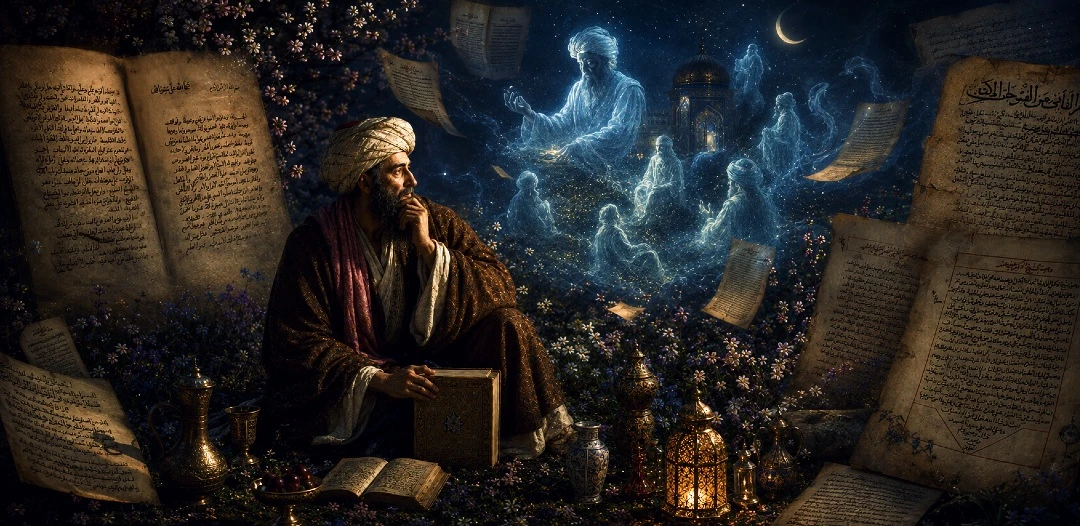
If we had to sum up Ibn Arabi’s relationship with the unseen world in a single word, it would be kashf (unveiling). Imagine a window covered by a curtain—what’s behind it exists, but you can’t see it. When the curtain is lifted, what was hidden becomes visible. This is essentially the idea of kashf in Sufism.
Ibn Arabi believed that while the senses and intellect are important, they can’t grasp every level of reality. Through dreams, visions, or spiritual experiences, a person might perceive things that are inaccessible in ordinary waking consciousness.
This explains why visions, encounters, and hidden worlds played such a major role in his life. For him, they weren’t just mental images, but possible windows into the unseen.
What Does Science Say?
From a modern perspective, there are various explanations for these kinds of experiences. The brain, especially during dreams, Lucid dreams, or exceptionally vivid dreams , During the states between sleep and wakefulness, as well as in certain deep meditative states, people can have experiences that feel incredibly real. Someone might see a person, hear their voice, sense their presence, or even have a full conversation with them. Similar experiences can also occur during what are known as altered states of consciousness (ASC), times when our perception works differently from our usual waking state. However, these explanations can't diagnose someone who lived eight centuries ago, and understanding the brain mechanisms behind such experiences doesn't answer the question that Ibn Arabi himself was concerned with:
Does everything that appears to our consciousness come from within, or can consciousness sometimes receive something from beyond itself?
Science can study dreams, hallucinations, and states of consciousness, but proving the existence of an independent 'imaginal world,' spirits we can communicate with, or mystical knowledge gained through revelation is something that scientific experiments have yet to confirm. The imaginal world For Ibn Arabi, this is an intermediate realm between matter and spirit, where meanings and spirits take on forms that can be seen and perceived.
Between the man and the legend
After Ibn Arabi's death, a vast aura grew around his persona, with sayings, prophecies, miracles, and stories attributed to him. many of which can't be verified. Yet the irony is that the real Ibn Arabi doesn't need these legends to stand out as an extraordinary figure in the history of the paranormal and spirituality.
His own writings reveal a man who claimed to have seen prophets, recorded his dreams, linked one of his most famous books to a vision, spoke of encounters with the departed in the afterlife, wrote about jinn, described spiritual journeys, and even devoted pages to the Mahdi and those who would surround him at the end of time.
And so, eight centuries later, the question remains:
Were these experiences simply lucid dreams? States of consciousness shaped by a lifetime of mysticism and meditation? Symbolic language for profound psychological experiences? Or did Ibn Arabi, as he believed, truly manage to lift the veil—if only for moments—on a level of existence beyond our senses?
Perhaps his appeal lies in the fact that he didn't see the world as simply divided into reality and imagination. Between them, a barzakh, a threshold or isthmus as he called it, where spirits, visions, dreams, jinn, hidden knowledge, and perhaps even some secrets of the end times reside.
About the Author