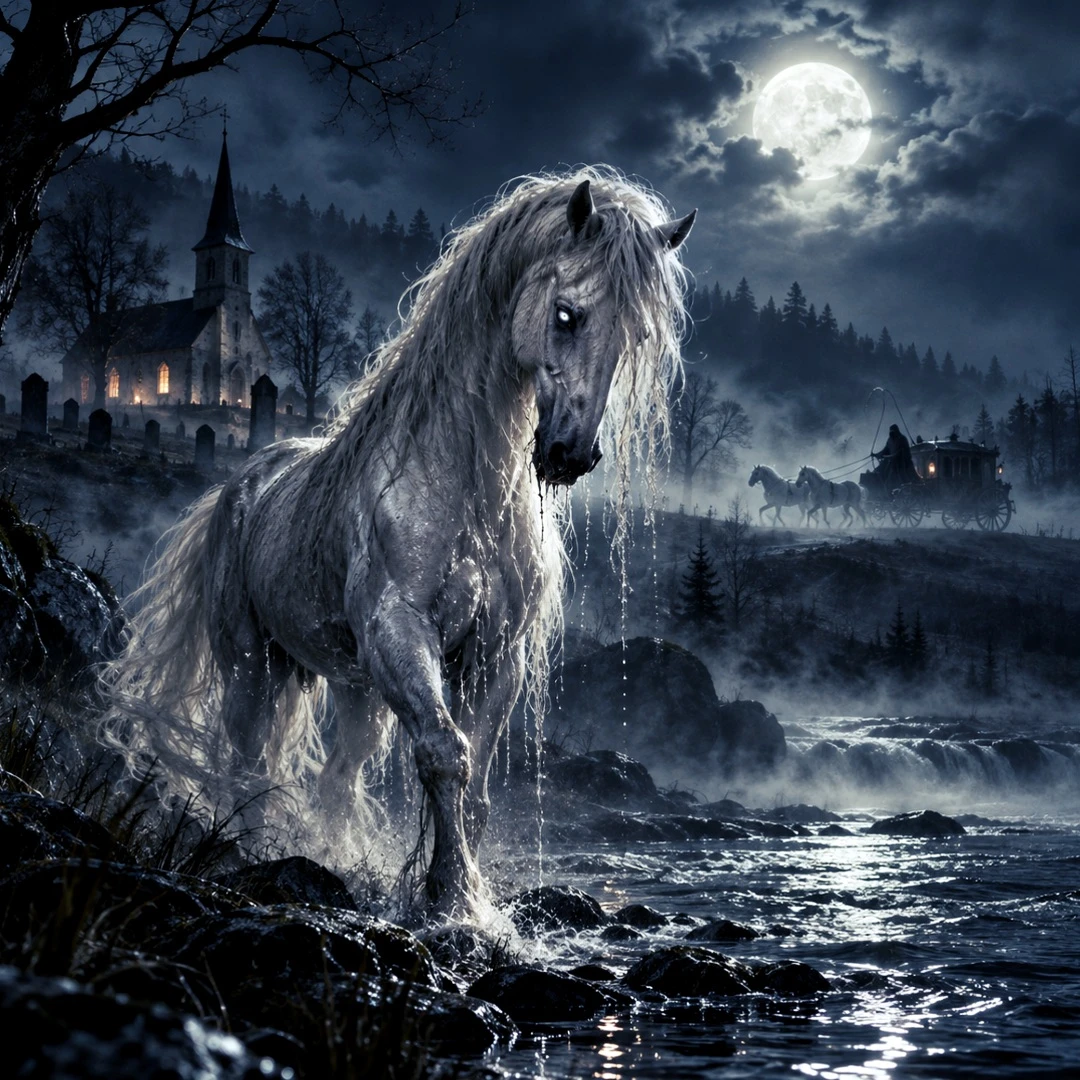
In the old Swedish countryside, before electricity reached the villages and roads, the night was far vaster than we know today. Black rivers wound through the trees, marshes stretched beyond sight, dirt paths vanished into the mist, and small cemeteries surrounded lonely churches standing in the fields. In such a world, the sound of unknown hooves in the darkness could easily spark a story but some of those tales weren’t about ordinary horses.
There was a white horse that would appear near the water, so beautiful and calm that it tempted children or travelers to approach. Some horses were said to have come from the realm of the dead, or to be connected to cemeteries and churches. In other stories, ghostly carriages raced along the roads at night, drawn by horses that didn’t belong to the world of the living. So how did the horse become one of the creatures most closely linked to death in Scandinavian folklore?
Were these stories simply old legends born of ancient fears, or did some of them have roots in real events that, over time, became tales of ghosts ?
The White Horse by the Water
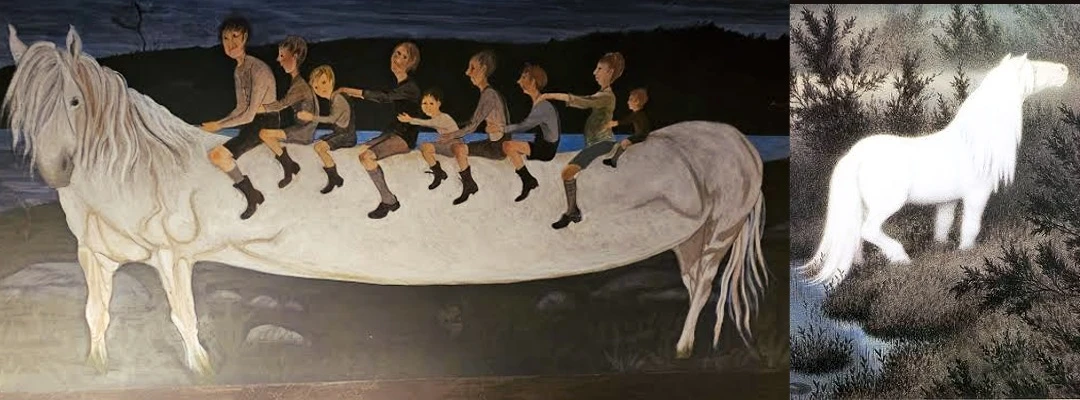
One of the most famous creatures in Swedish folklore is the Bäckahästen, or "river horse." According to popular legend, it appears by rivers, streams, and lakes as an extraordinarily beautiful horse, usually white. It seems tame and gives no reason for fear, in fact, it might act as if it’s waiting for someone to ride it. Children are often the first to fall into its trap: one climbs onto its back, then another, then a third. Logically, the horse’s back shouldn’t be big enough for them all, but it begins to stretch unnaturally, growing longer with each new rider. Five children, ten, maybe more, there’s always room. But once its back is full, the innocent part of the story ends. Suddenly, the Bäckahästen charges into the water, plunging its riders into the depths. No one ever returns.
This isn’t just a modern ghost horse story, it’s a well-documented part of Swedish folklore, especially in the south, including Skåne, western Blekinge, and southern Halland. But behind the horse lies an even older and more famous being.
A Water Spirit Transformed into a Horse
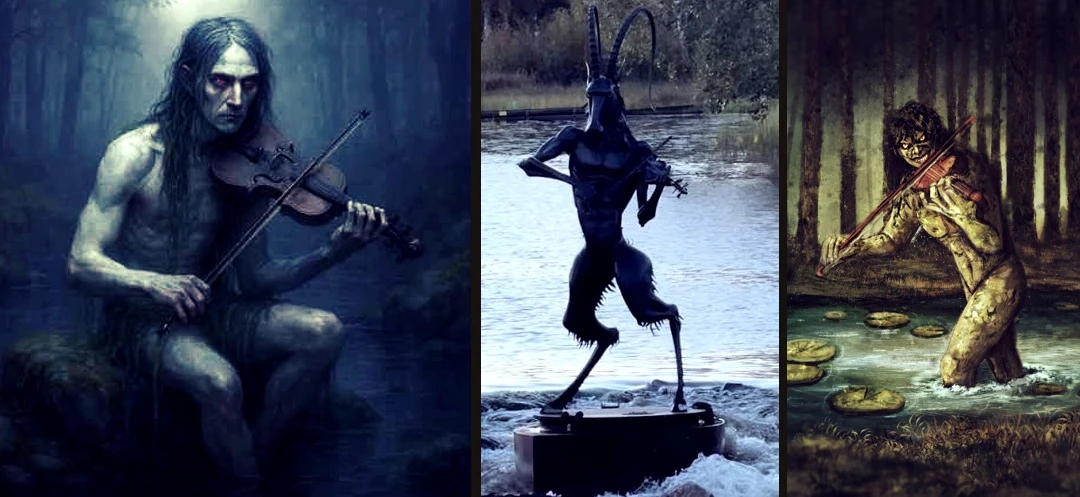
Swedish folklore tells of a water spirit called Näcken, associated with rivers, lakes, and streams. In some stories, it appears as a man; in others, as a supernatural musician playing by the water to lure people in. But Näcken wasn’t limited to a human form, it could transform, appearing as a goat, a dog, a cat, or other animals. One of its most important forms was the horse.
That’s why the line between Näcken and the Bäckahästen isn’t always clear. In some parts of southern Sweden, the image of the water spirit and the horse merged so completely that the "river horse" became almost a creature in its own right. The white horse by the water is more than just a ghostly animal, it’s a mask worn by a mysterious force from the watery world.
In old folklore, water wasn’t just a natural element, it was a boundary. On one side stood humans; on the other, something unknown.
The Horse from the Lake
The Swedish folklore archives contain stories even stranger than the classic tale of the children. In one, a farmhand went out to gather the horses near a place called Sjövik, but noticed a horse among them he didn’t recognize.
The animal was strikingly beautiful, with nothing to suggest it was wild or supernatural, though it kept trying to return to the lake. The man managed to control it and brought it back to the farm, where, according to the story, it lived for years among the other animals.
Over time, it seemed to become part of the place until the day its owners decided to let it roam free. As soon as they released it, the horse disappeared and was never seen again.
The storyteller’s explanation was simple: it wasn’t an ordinary horse, but Näcken’s horse, finally returning to where it came from.
This story gives the Bäckahästen a very different face. Not every water horse in Swedish tradition is a monster waiting for victims. Sometimes, it’s a being that lives temporarily between two worlds, able to blend in with ordinary animals before vanishing from human life as mysteriously as it arrived.
In another tale from Halland, a woman said she saw Näcken one evening crossing part of a lake, but this time, Näcken wasn’t the horse. He was an old man riding on its back, as if folklore itself couldn’t decide where the creature ended and its mount began.
The Horse That Returned After Its Owner's Death
Not every ghostly horse in Sweden is a water spirit. In a folk account from the Gillberga region, there's a very different story: a white horse was said to appear at the steps of a large country house called Älgå herrgård.
Why did it appear there?
According to local legend, a rider once took this horse to a nearby river, where he drowned. Over the years, the rider’s death became linked to sightings or reported sightings of the white horse near the house.
This isn’t a familiar mythical creature like the Nøkk, but rather a type of story found in ghost tales around the world:
A tragic death occurs in a certain place, and over time, the community begins to associate the location with supernatural events. Perhaps this is one way ghost stories are born.
From Water to the Graveyard
The connection between horses and the afterlife isn’t limited to rivers. In Scandinavian folklore, there’s the concept of the kyrkogrim, a spirit or creature that guards the church and its graveyard. Some stories say that when a church was built or a cemetery consecrated, an animal would be buried there to become its spiritual guardian. The animal’s identity varies: sometimes a dog, sometimes a pig, and in some Swedish tales, a foal or a horse.
One story from Berg Church tells of a foal buried during the church’s construction to protect the site from evil forces. However, these stories don’t mean that burying live animals under churches was a widespread historical practice; what we have is a folk tradition that preserves the belief that churches need a guardian, even after dark. Once again, the horse is linked to the world of the dead.
But there’s another legend that often gets mixed up with this one.
The Three-Legged Hell Horse
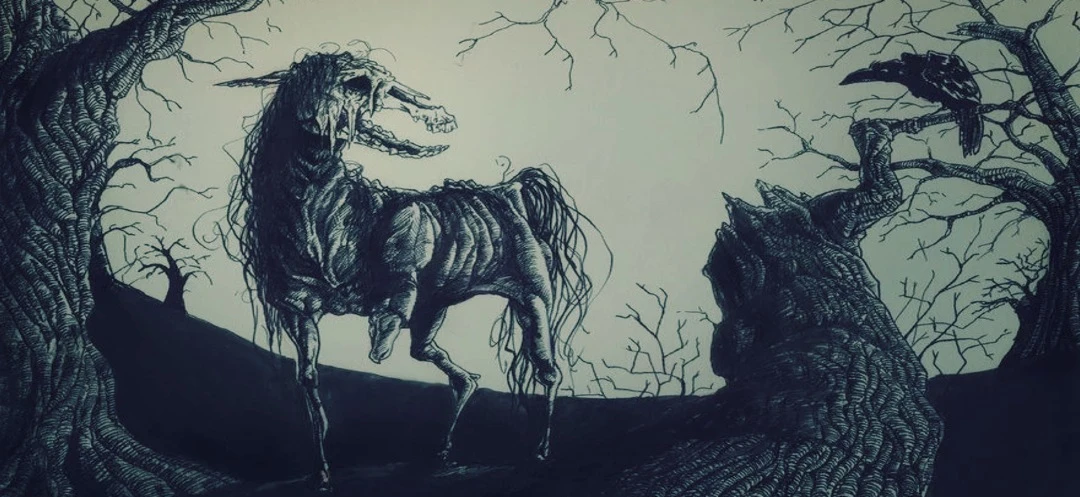
Some modern articles mention a creature called the 'Hell Horse' (Helhest), which appears near cemeteries and walks on three legs. Hearing its strange footsteps was considered an omen of illness or impending death. In some versions, simply seeing the animal was a bad sign. However, a closer look reveals an important detail: this tradition is rooted more in Danish folklore than Swedish.
Danish sources mention stories of the Hell Horse dating back to at least the 17th century. It sometimes appears with three legs, sometimes headless, and roams near churches and graveyards as a harbinger of death.
This similarity to the Swedish kyrkogrim may have led to the two stories being blended together over time.
In Denmark’s Roskilde Cathedral, there’s even a grave popularly associated with the so-called 'Hel Horse.' But archaeological investigation revealed an interesting twist: the grave didn’t contain a horse at all, only human remains. In fact, the grave predates the legend attached to it, the place existed first, and the story came later, giving it new meaning.
Hoofbeats Before Death
A horse doesn’t always have to appear as a clear ghost to be seen as an omen. Swedish folklore includes references to wild horses or unusual horse sounds being linked to approaching death. This reflects one of the oldest features of folk omens: the event itself isn’t necessarily frightening.
A horse running at night, hoofbeats outside a window, or an animal appearing in an unexpected place—these might seem ordinary, but if someone dies soon after, memories are rearranged to fit the story.
We heard the horse before it died.
When a pattern keeps repeating itself within a small community, it gradually shifts from being seen as a coincidence, to a sign, and eventually to a belief.
The Death Carriage
The most famous image of Sweden’s ghostly horses wasn’t born in the countryside or in the memories of rural folk. It’s the carriage driver, known as Körkarlen.
In the story made famous by Swedish author Selma Lagerlöf’s 1912 novel, there’s a chilling rule for New Year’s Eve: the last person to die before midnight doesn’t immediately pass on to the afterlife. Instead, they become death’s servant for an entire year.
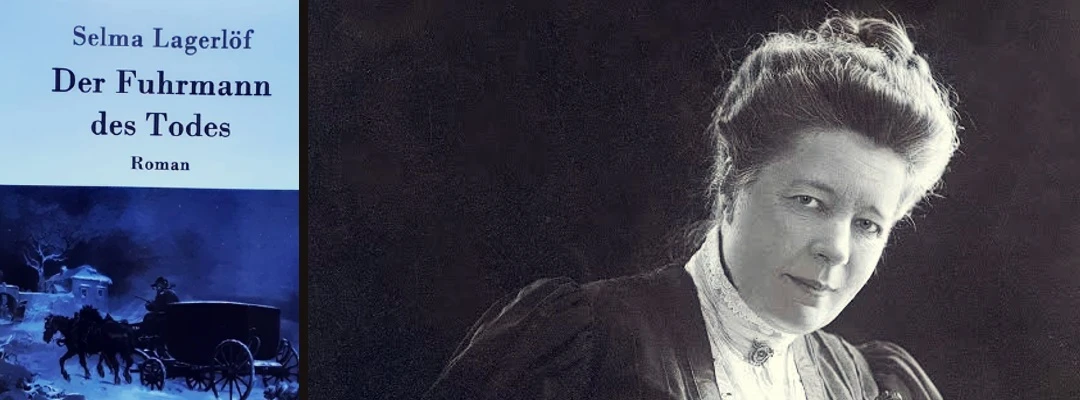
This person takes charge of an old carriage drawn by spectral horses, spending the next year traveling the roads to collect the souls of the newly dead. When the year ends, a new deceased person takes their place. The idea is so powerful it feels ancient, as if it must be one of Sweden’s oldest legends—but the truth is surprising.
Literary studies of the novel reveal that Lagerlöf drew significant inspiration from a French legend about a death carriage and its driver, then reimagined it in a Swedish setting. The novel itself was closely tied to a very real context: the fight against tuberculosis, a disease that claimed many lives at the time. The ghostly carriage became intertwined with a real epidemic, blending imagined death with daily reality.
When people saw the Death Carriage
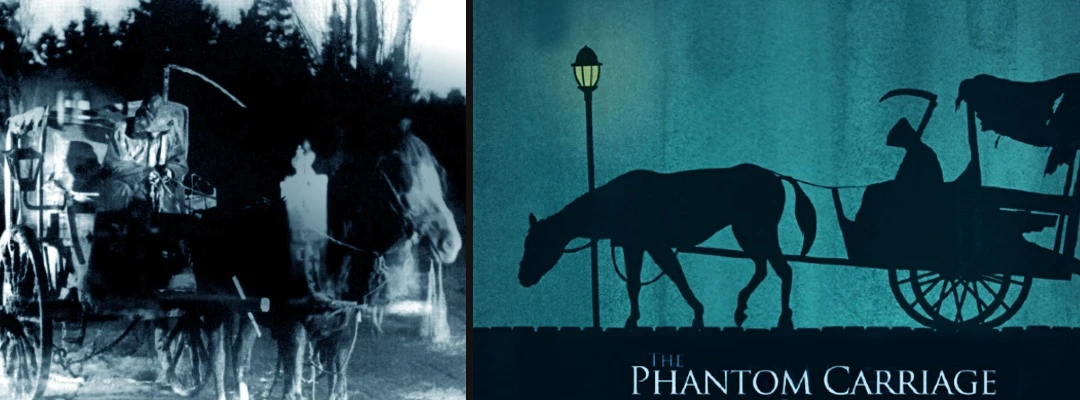
In 1921, the novel was adapted into a silent film titled Körkarlen – The Phantom Carriage. Visual effects played a crucial role in cementing its iconic imagery.
A transparent carriage, ghostly horses, and souls moving between the worlds of the living and the dead—the film’s visuals were so striking that later generations might mistake them for authentic depictions of ancient Swedish folklore. In reality, it’s a blend of legend, literature, European influences, and modern cinema.
This is a familiar pattern in the history of myths:
It becomes hard to tell where folklore ends and art begins.
Why the horse?
So why the horse? For centuries, the horse held a special place in Scandinavian societies—as a means of travel, a symbol of status, a companion in war and work, and even as part of funeral rites and pre-Christian sacrifices.
Archaeological graves across Scandinavia often contain horses, horse parts, or riding gear buried alongside the dead. While there’s no direct evidence linking the 'brook horse' or 'carriage driver' to any specific Viking-era belief, it’s likely these stories are layers built up over centuries.
Still, the horse’s ancient status may have made it the perfect candidate for the role of guide between worlds. If it carried people across distances in life, why not across the final boundary as well?
Protector of children, or their threat?
The 'brook horse' also had a more practical explanation. Before modern barriers, lighting, and rescue services, rivers posed a real danger to children.
Deep water, swift currents, slippery banks, and limited swimming skills made rivers hazardous. A father could warn his child, 'Don’t go near the river, it’s dangerous,' but a more vivid warning might stick in a child’s imagination:
'Don’t go near the water, there’s a horse waiting for you.'
From this perspective, the monster shifts from being a child-killer to a creature paradoxically invented by adults to protect children.
Researchers of Swedish folklore have already noted the cautionary role played by these water-related creatures.
A legend doesn’t need to be true to serve a real purpose.
Did people actually see something?
There’s also a simpler explanation: before electric lighting, nighttime was very different. A distant white horse in the fog could appear featureless, and moonlight reflecting off the water might make a moving shape look unfamiliar.
Low-lying mist over the river can hide an animal’s legs, making it seem as if it’s floating. Sound travels differently over water, so a noise might seem closer or farther than it really is. Memory and cultural expectations then fill in the rest.
But someone who already knows the story of the 'stream horse' might not just see a horse by the river, they see Bäckahästen itself.
When events create their own ghosts
Some stories may have started differently: a rider drowns in the river, years pass, someone spots a white horse near the site, locals remember the drowning and share the story. After a generation or two, no one recalls the rider’s name or the date, but the horse remains.
This is a familiar process in the making of local legends: historical details fade, while the community holds onto the most powerful image in this case, a white horse waiting at the spot where its owner died.
Death rides a horse
There’s probably no single answer that explains all the horses in Swedish folklore.
Bäckahästen seems tied to the dangers of water and serves as a warning.
Kyrkogrim reflects fears of graveyards and the need for a guardian to protect sacred ground.
Local tales of ghostly horses can also arise from real-life tragedies.
Körkarlen shows how literature and film can borrow a legend from elsewhere and replant it in a new culture, until it becomes part of that culture’s own identity.
But there is a common thread running through them all.
The horse moves, crosses boundaries, and carries people from one place to another.
Perhaps that's why, in ancient imagination, this creature was always found at the threshold—by the water's edge, at the cemetery gate, along a dark road, or between the end of one year and the start of another.
In a world where death was neither distant nor hidden as it is today, the sound of unknown hooves at night might have been enough to spark a single question:
Is it just a passing horse outside the house, or has someone come to claim their final rider?
About the Author