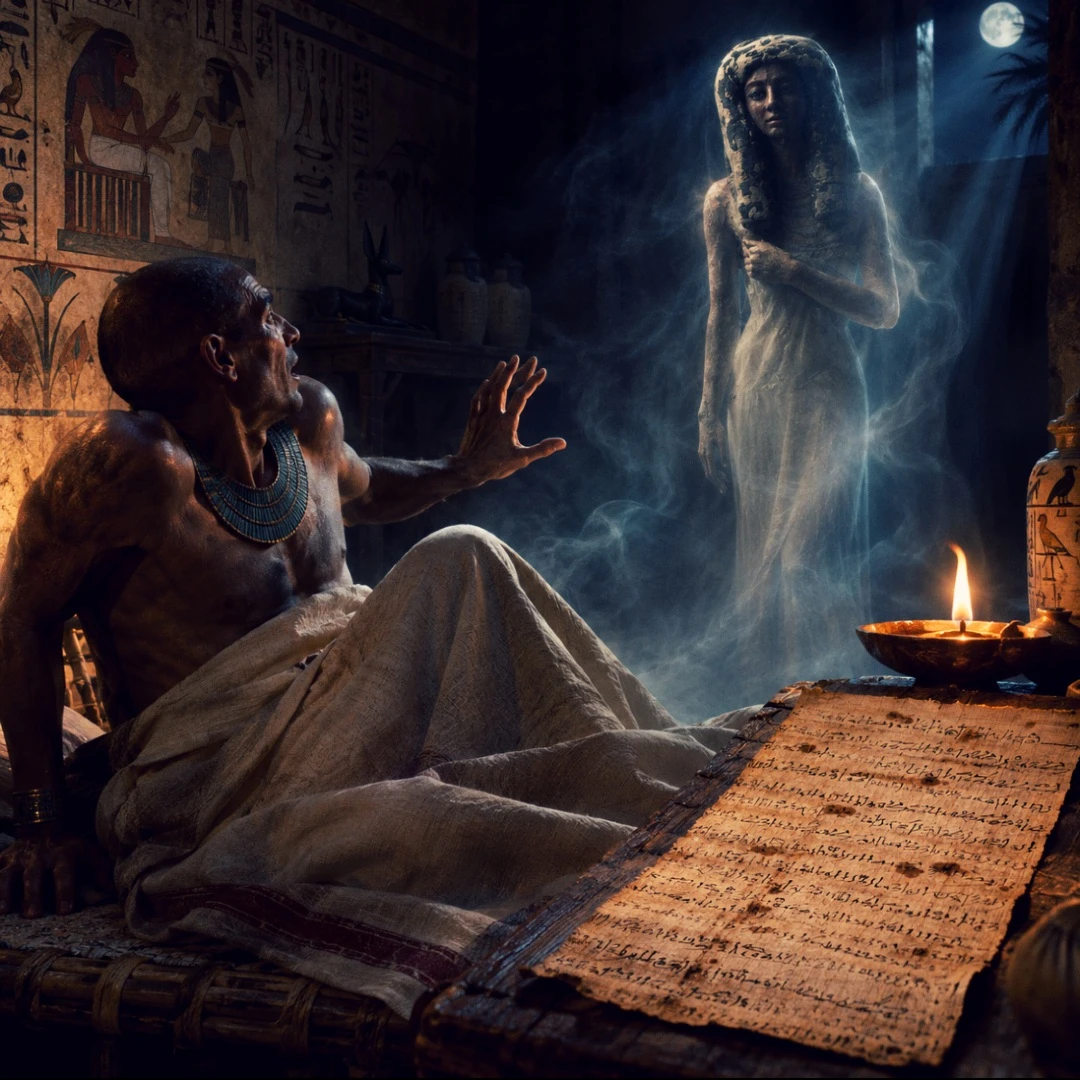
Over 3,200 years ago, an Egyptian man wrote a strange letter to his wife who had died three years earlier. Rather than a message of longing or mourning, it was an angry complaint, accusing her of causing his suffering from beyond the grave. According to his account, he had been a devoted husband, never neglecting her in life or after her death. Most remarkably, he threatened to take her to court before the gods of the afterlife if she didn’t stop tormenting him.
This isn’t a fictional tale. The letter survives on an ancient Egyptian papyrus, written in hieratic script and known as 'Leiden Papyrus I 371.' Today, it’s housed in the National Museum of Antiquities in Leiden, Netherlands.
The document offers a rare glimpse into ancient Egyptian beliefs, revealing that death didn’t necessarily end human relationships. The Egyptians imagined that the spirits of the dead could continue to influence the lives of their loved onesو sometimes helping, sometimes causing harm.
A Wife by His Side During His Rise
The papyrus dates back to the 19th Dynasty of Egypt’s New Kingdom, around the 13th century BCE, a period that saw pharaohs like Seti I and Ramses II. The author’s name is lost to history, but the letter suggests he was a high-ranking officer in Memphis, responsible for training infantry and chariot forces in the pharaoh’s army. His wife was named Ankhiry.
The letter opens with a question full of indignation, which could be rendered in English as:
"What wrong have I done to you to deserve this misery? What did I ever do to you? ".
He then accuses his late wife of 'laying her hand upon him,' implying she was causing him harm from the afterlife, despite his having done her no wrong. He recounts their marriage as if making a case before a court: he married Ankhiry in his youth, and she remained by his side as he rose through the ranks. He never abandoned or divorced her, even after achieving social status. He insists he always treated her with respect, even instructing the officers he trained to pay her homage and bring her gifts. He claims he never deprived her of anything, never allowed her to be insulted, and never betrayed her with another woman.
Her Illness and Death
Later, Ankhiry fell ill, though the papyrus doesn’t specify the illness. Her husband summoned a prominent physician, but she could not be saved. At the time of her death, he was accompanying the pharaoh on a journey to southern Egypt. He describes a period of deep grief, during which he could barely eat or drink, and his suffering lasted for months. When he returned to Memphis, he sought the pharaoh’s permission to go back and mourn her. He joined his family and men in weeping for her, personally oversaw her burial, provided fine linen for her shroud, and arranged for all the necessary funerary goods. These actions were not just signs of respect, they reflected Egyptian beliefs about the afterlife and the importance of preparing the deceased with offerings and proper rites.
Three Years After Death
After recounting her illness and death, the man reveals that three years have passed since Ankhiry’s departure. He has not been with another woman in all that time, out of respect for her memory. Yet, he believes that her spirit is deliberately causing him harm, and that his suffering is the result of her interference from the afterlife. The papyrus doesn’t specify the nature of this harm, there’s no mention of ghostly apparitions, mysterious voices, or attacks by invisible forces. All we know is that he felt deeply troubled and blamed his late wife. At this point, the tone of the letter shifts from reminiscence to confrontation: he accuses her of repaying his kindness with cruelty and demands that she stop. Notably, he addresses her not as a memory, but as a conscious spirit capable of understanding and responding to his accusations.
A Dispute Before the Court of the Afterlife
The letter reaches its climax when the husband declares his intention to bring his case against his wife before the 'Ennead of the West', the group of gods associated with the afterlife. In ancient Egyptian belief, the west was linked to sunset and the realm of the dead, so invoking these gods implied a belief in posthumous justice. The man seems convinced he has the right to file a complaint against his wife’s spirit, and that the document he’s writing will serve as testimony in their dispute. The letter doesn’t include a response from Ankhiry, and we don’t know whether the husband found relief after writing it, or if he ever stopped believing she was haunting him.
A Papyrus Placed with the Wife’s Statue
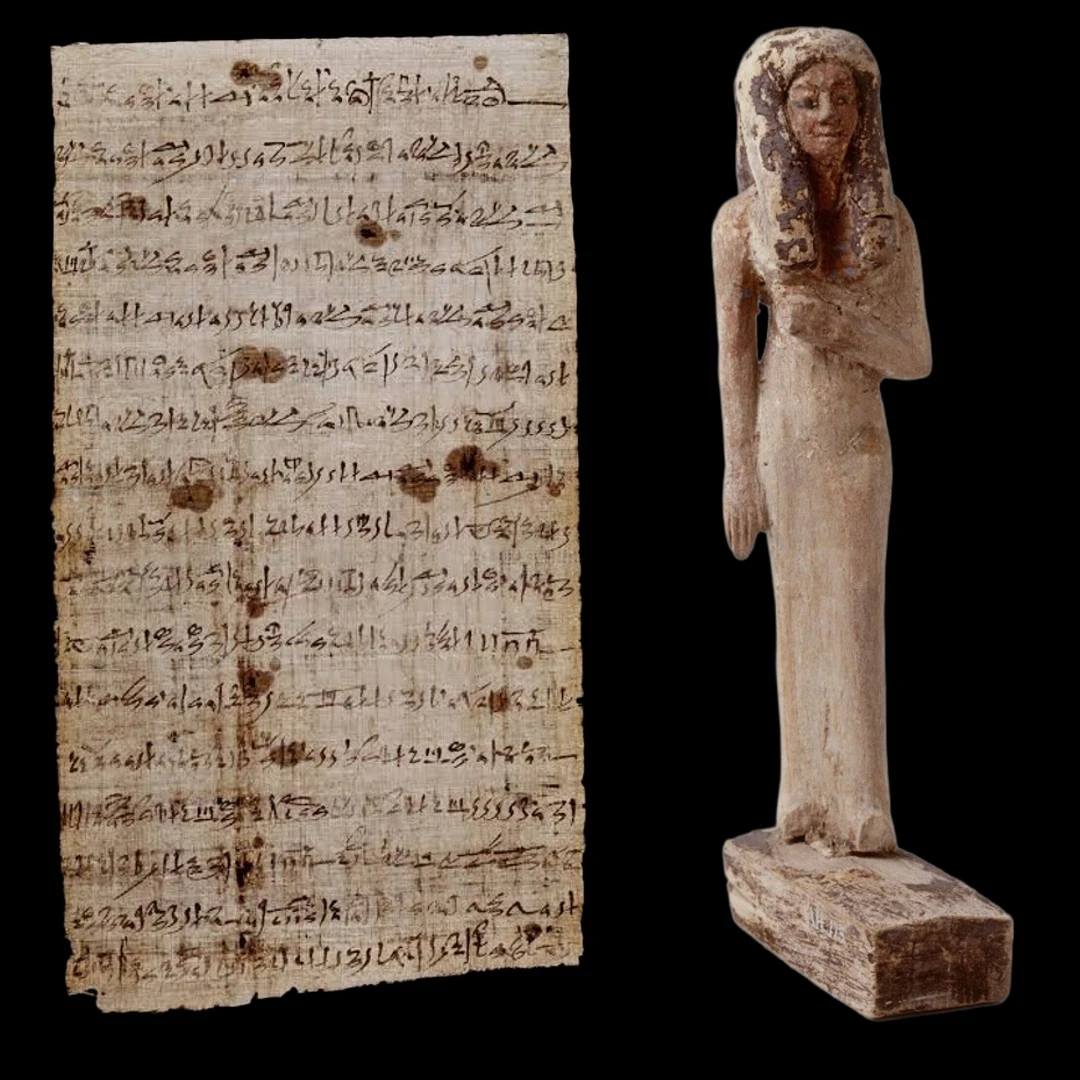
The story gains extra significance from the circumstances of the papyrus’s discovery. It was found tied to a wooden statue representing Ankhiry, likely placed together in her tomb. The statue, now in the Leiden museum as item AH 115, depicts a woman in a long white dress with a black wig, her feet are missing. The letter itself is written in 38 lines on both sides of the papyrus, using black ink in the hieratic script, a cursive form of hieroglyphs used for letters and daily records. According to the museum, the text contains errors, repetitions, and additions, and the lines become crowded toward the end, making some passages difficult to read.
The presence of the letter with the wife’s statue had religious significance. Ancient Egyptians viewed statues and funerary images as symbolic vessels for the presence of the deceased, allowing the living to make offerings and communicate with them. The piece entered the museum as part of a collection acquired from Giovanni d’Anastasi in the 19th century. The papyrus is now catalogued as AMS 64, in addition to its historical name 'Leiden I 371.'
Communicating with the Dead in Ancient Egypt
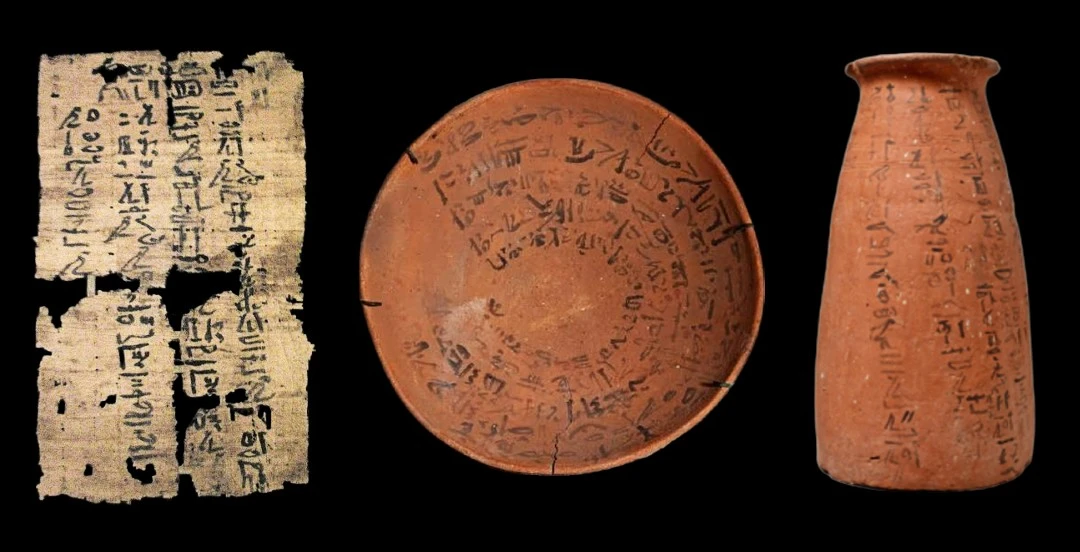
Writing a letter to someone who has died might seem unusual today, but it was a known practice in ancient Egypt. Researchers have discovered a collection of documents called 'Letters to the Dead,' written by the living to their deceased relatives, asking for help, protection, or intervention in family disputes. The earliest examples date back to the late Old Kingdom and this tradition continued in later periods. These letters were inscribed on pottery, papyrus, linen, and funerary stelae, and were often placed in or near tombs. The practice was closely tied to the religious concept of the 'Akh,' a term for a spirit that had achieved a state of effectiveness and honor after proper funerary rituals.
This spirit wasn't exactly like the ghosts of modern stories, but was believed to be a being capable of helping or harming the living. Family members might appeal to the spirits of their relatives for healing or protection from injustice, but could also blame them for illness or misfortune if they thought the spirit was angry. One well-known example comes from letters found in Qau el-Kebir, where a man named Shepsi complains to his deceased parents about being wronged in a property dispute and asks for their intervention. In ancient Egyptian belief, the tomb wasn't just a place to store the body, it was a space where communication between the living and the dead could continue.
Why did the husband believe his wife's spirit was harming him?
Although the accusation in the papyrus is clear, the reason the man believed his deceased wife was responsible for his suffering remains unknown. His complaint can be interpreted in three possible ways:
Fear of an angry spirit
The man may have experienced illness, nightmares, or a string of misfortunes, and, following the beliefs of his society, attributed them to his wife's anger. Egyptians believed that the spirits of the dead could influence the lives of the living, and some spirits were thought to cause illness or disturbances. His letter can be seen as an attempt to stop the harm he believed her spirit was causing, by reminding her of his kindness and threatening to hold her accountable before the gods. However, the document does not show that he actually saw a ghost or experienced any specific supernatural event.
Infidelity or the desire to remarry
The husband's insistence on denying infidelity and his claim that he hadn't been with another woman in the three years since his wife's death is striking. Was he feeling guilty about a past relationship, or was he considering remarriage and believed his wife's spirit disapproved?
The National Museum of Antiquities in Leiden discussed this possibility in a 2017 exhibition, suggesting that the letter's content might reflect tension related to jealousy and marital relationships, especially since the man ends by denying any intimate relations with women in his household. Still, these statements don't prove actual infidelity, they remain a possible interpretation, not a confirmed historical fact.
Grief and guilt
It's also possible that prolonged grief over his wife became mixed with feelings of guilt and anxiety, especially since he describes changes in his eating and drinking habits after her death. In a society that believed the dead continued to be present and influential, such feelings could turn into the belief that the deceased was watching or punishing the living. However, it's impossible to diagnose his psychological state from a single papyrus or to say for certain that his suffering was due to a mental disorder.
Does the letter prove the existence of ghosts?
Historically, the Ankheri papyrus is evidence that some ancient Egyptians believed the spirits of the dead could intervene in the lives of the living. However, it doesn't prove that any supernatural event actually occurred. The letter records a personal experience, a man convinced his deceased wife was harming him—but it doesn't describe a specific, verifiable incident or include any independent testimony confirming the phenomenon.
Its real significance lies in showing how an ancient Egyptian interpreted his suffering. He didn't see his wife's death as the end of their relationship, but believed she could still affect him and that he had the right to ask her for justice.
A letter that went unanswered
The story of Ankheri offers a different perspective on life in ancient Egypt, beyond temples, mummies, and royal tombs. Behind that civilization were people who experienced love, jealousy, loss, and fear, and whose beliefs led them to interpret some of their experiences as part of an ongoing relationship between the living and the dead.
We don't know what happened to the husband after he wrote his letter whether he remarried, or if he felt his wife responded and left him in peace. The papyrus survived, but the details of the dispute that prompted him to write it have been lost.
Perhaps the strangest thing about this document is that the writer didn't ask his wife to return from the dead or write to express longing. Instead, he pleaded with her to stop harming him and let him live in peace.
In his eyes, Ankheri was gone from the world of the living, but she had never truly left his life.
About the Author