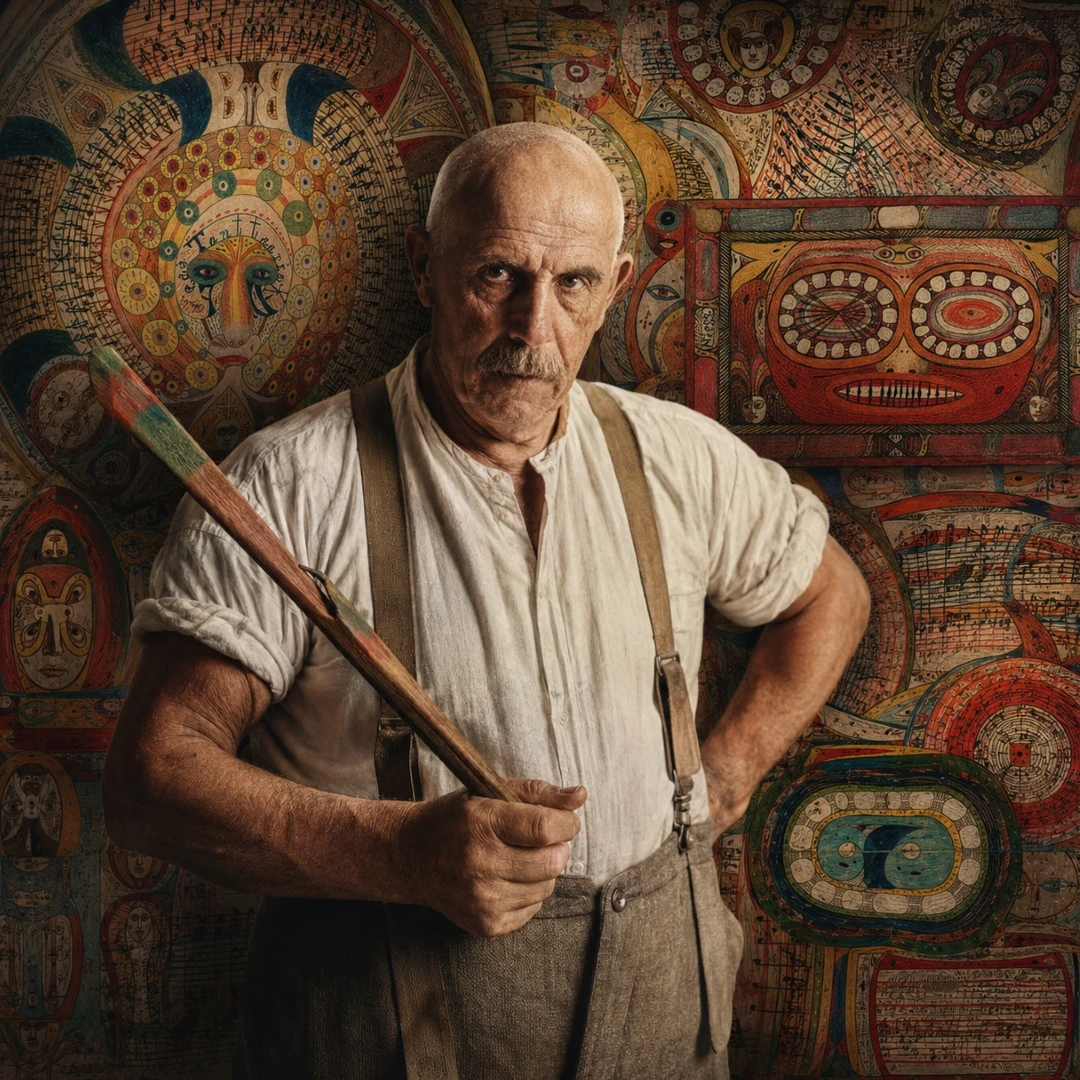
Some artists paint the world as they see it; others create worlds that exist only in their imagination. Adolf Wölfli stands among the latter—a peculiar Swiss man who entered a psychiatric hospital troubled and accused, and emerged, not in body but in spirit, to construct one of the most extraordinary artistic kingdoms of the twentieth century.
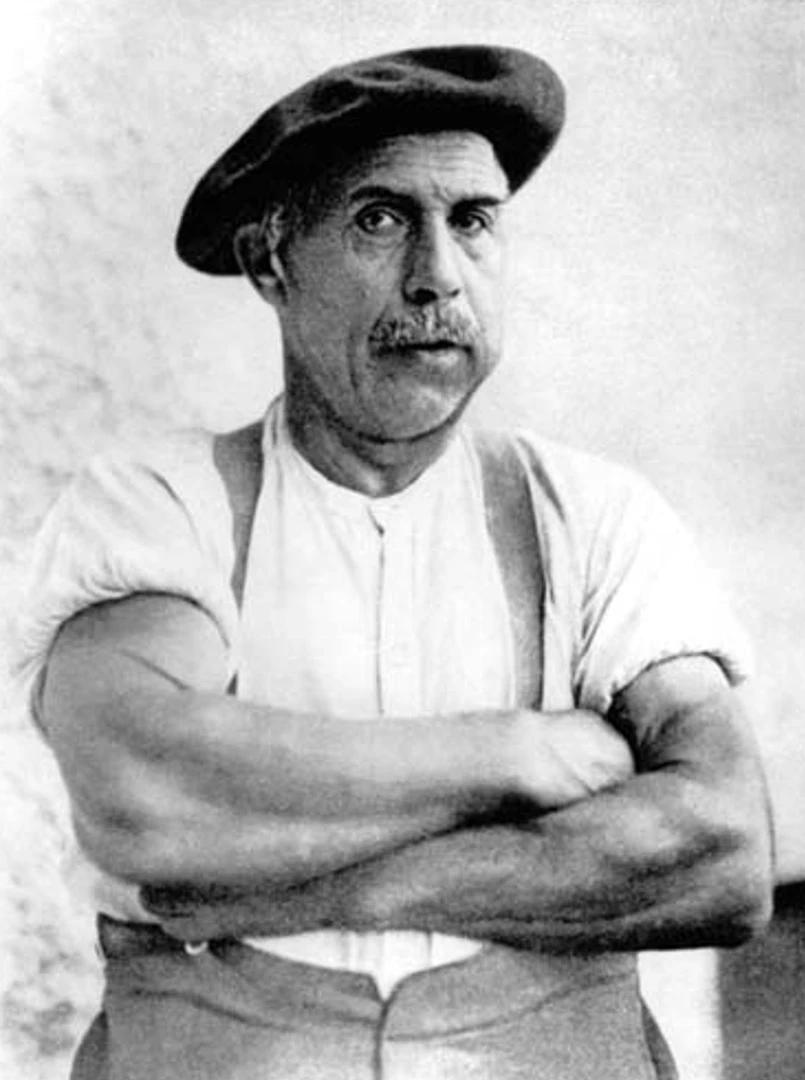
Wölfli was not a painter in the traditional sense. He never attended an academy, never learned the rules of perspective, and never lived the life of elegant studios and art salons. He was a psychiatric patient at the Waldau Clinic near Bern, confined by institutional walls, haunted by a harsh childhood, and living with a mind that no longer processed reality like everyone else.
And yet, perhaps because of this, he created a vast universe of drawings, maps, music, numbers, poems, imaginary cities, and symbols, some of which resemble spells or manuscripts from a lost civilization.
His story raises a perplexing question: Was his art a form of therapy, or a structured delirium? Did he invent a fantasy world to escape reality, or was he truly living in an alternate reality that the rest of us simply cannot access?
A Child Without a Home
Adolf Wölfli was born in 1864 in Switzerland, into poverty and turmoil. The youngest of several children, he grew up in a family marked by hardship. His father abandoned them, his mother died, and he was left to a harsh existence, passed between farming families who treated him more as a laborer than a child in need of care. His childhood was not just marked by poverty, but by an early uprooting from safety, home, mother, and the basic sense that the world could be trusted.
This background is key to understanding his later artistic project. The man who would go on to build an entire empire on paper within the asylum had, as a child, no kingdom, no protection, and no happy memories to look back on. So he rewrote his past as he wished: transforming the miserable child into a heroic traveler, the outcast into a saint and emperor, and the emptiness that swallowed him in real life into a teeming universe with not a single blank space.
Here, art is not a pastime or decoration, but a monumental act of compensation. It's as if Wölfli sat before a blank page and declared to the world: If you have taken my life from me, I will invent another—greater than any of yours.
Crime and the Asylum: The Dark Side of the Story
Wölfli cannot be seen only as a victim. In his youth, he was involved in crimes and attempted sexual assaults, incidents that ultimately led to his imprisonment and, after a psychiatric evaluation, his admission to the Waldau Clinic in 1895. This is a sensitive but necessary point: Wölfli was not just an eccentric artist, but a deeply troubled and, at times, harmful individual. This makes his story more complex—and much darker.
At the clinic, he was diagnosed with what was then called 'Dementia Paranoides,' a historical diagnosis roughly corresponding to what we now understand as psychotic disorders or schizophrenia.
He suffered from a chronic mental illness, and some studies note that his early years in the asylum were marked by difficulty, aggression, and erratic behavior. But a remarkable transformation began when he was given paper and pencils.
Here lies the great paradox: the same hand associated with a troubled past began to produce astonishing works of art. This does not excuse his actions or erase the harm he caused, but it does make his humanity more complex. Art does not make someone a saint, and illness does not absolve them of their actions. Yet sometimes, art reveals that even in the most disturbed individuals, there are labyrinths that cannot be summed up in a single word.
Drawing in Isolation
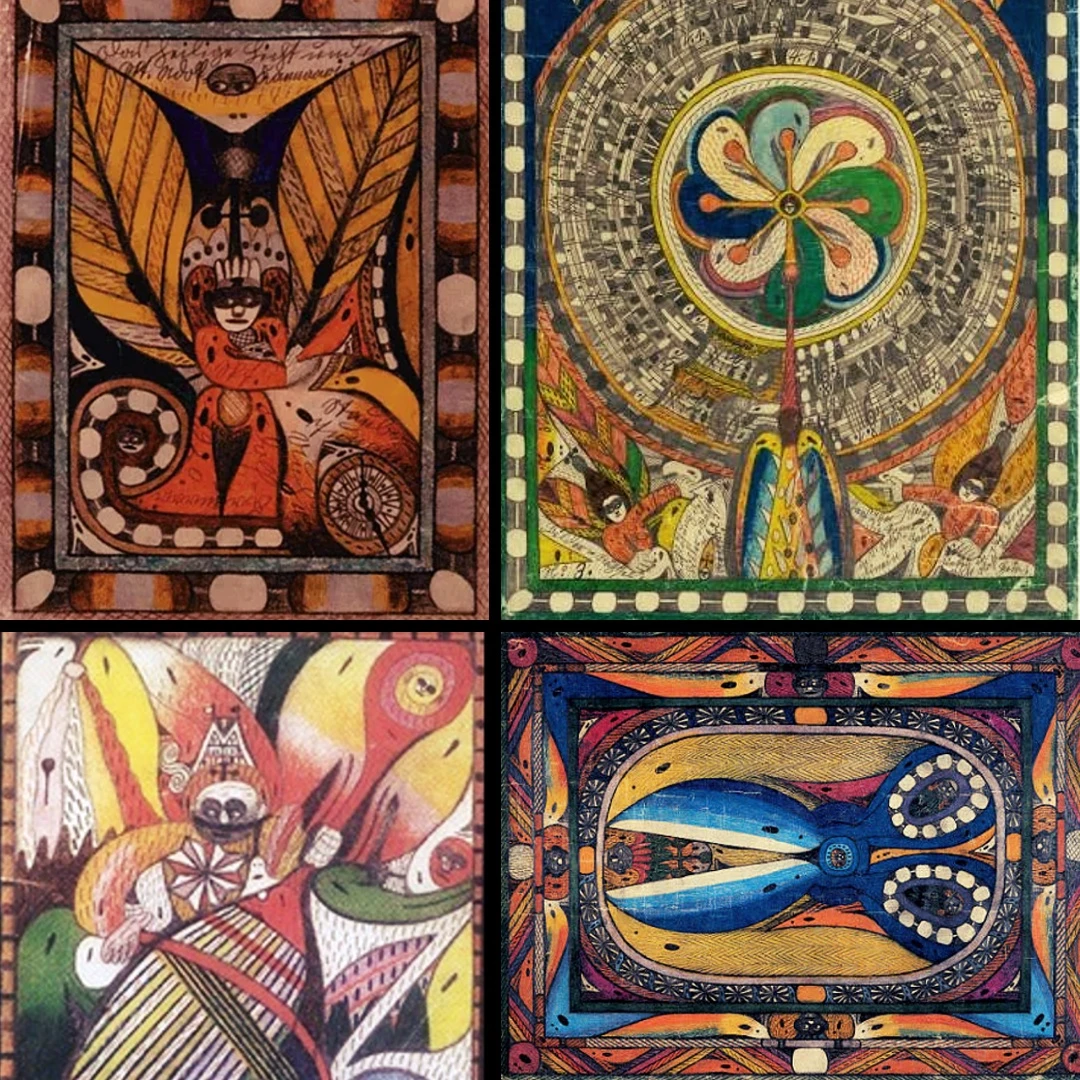
Wölfli began drawing around the age of thirty-five. For him, drawing was not an aesthetic exercise but an inner compulsion. He filled every inch of paper, as if afraid of emptiness—leaving no white space untouched by a line, a face, a number, a word, a musical note, a pattern, or a frame. This phenomenon is known in art as 'horror vacui,' the fear of empty spaces. But for Wölfli, it was more than a style—it was a psychological need to seal every gap through which nothingness might creep in.
His works are never simple compositions; they are closed systems. Every element is framed, every face surrounded by ornament, every word woven into a network, every line leading to another. The eye finds no rest. It's as if the viewer has entered a mental room where silence is not allowed.
Was it beautiful? Yes, in a strange way. Was it comforting? Never.
Wölfli’s beauty is both captivating and unsettling. It’s a dense, suffocating, ritualistic beauty—like staring at a page from a magical book written in an unknown language, hinting at a strict order that you’re not meant to fully understand.
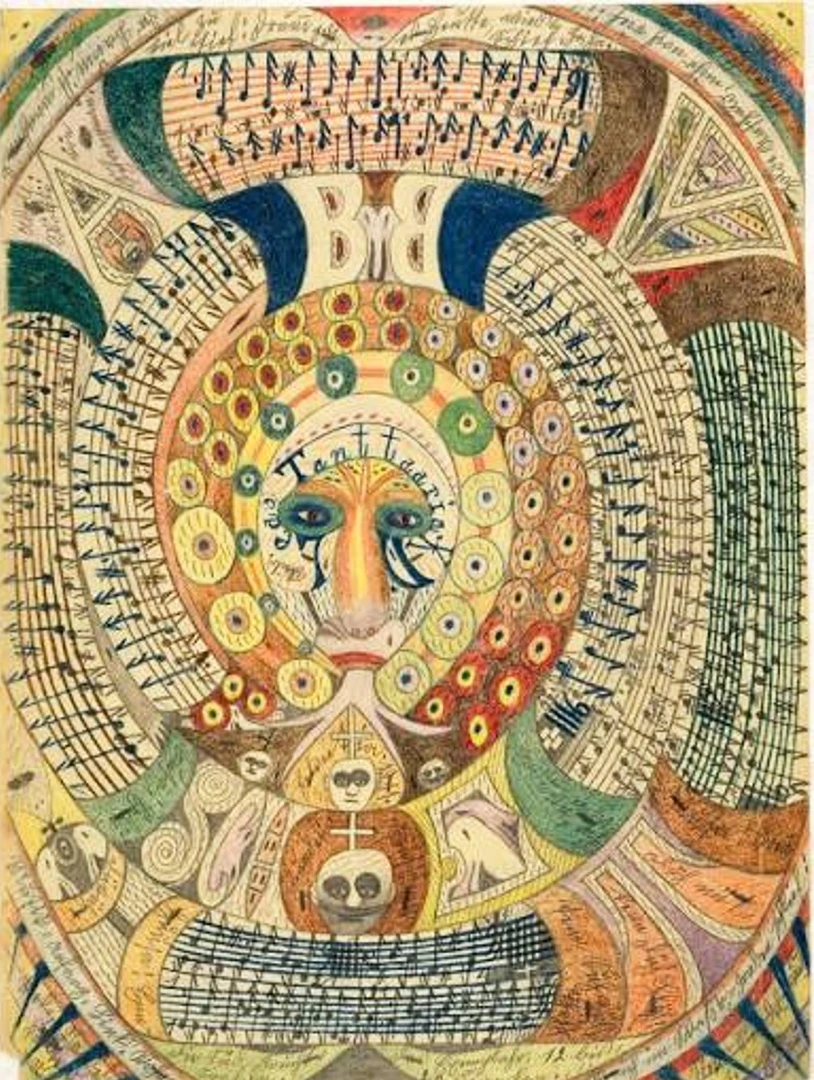
"The Creation of St. Adolf the Giant"
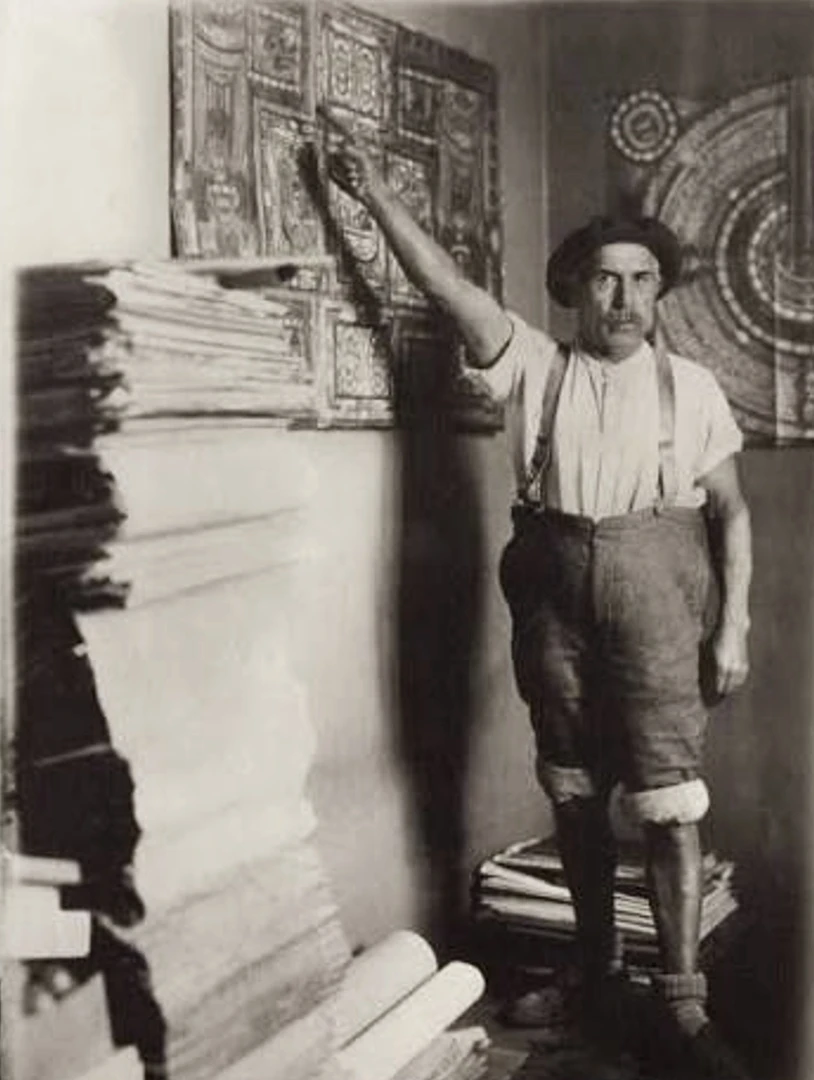
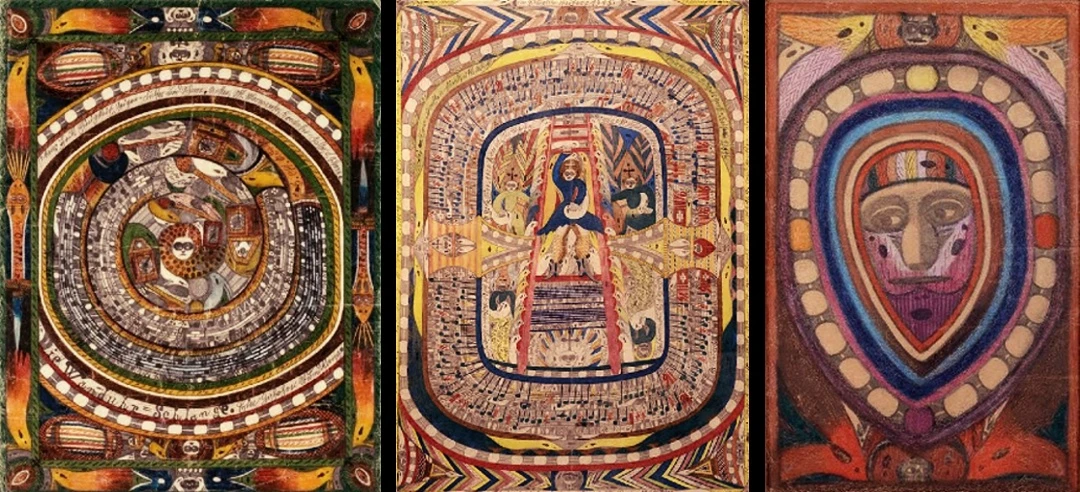
Between 1908 and 1930, Wölfli embarked on his most ambitious project—a nearly impossible feat in both scale and strangeness. He wrote, drew, and composed nearly 25,000 pages, all bound in massive volumes he crafted himself. These weren’t ordinary diaries, but an entire universe: an imagined autobiography, global journeys, maps, calculations, hymns, music, wars, cities, continents, fantastical riches, and personal transformations in which Wölfli rises from a miserable man to a legendary figure he named St. Adolf II.
He called his world "St. Adolf-Giant-Creation," a name that says it all. He wasn’t just drawing a city or telling a story, he was creating. Here, the artist is no longer a witness to the world but a small god within his own pages. He renames places, buys planets in his imagination, extends his power over the universe, invents enormous numbers, languages, and rhythms that belong to him alone.
At this point, Wölfli’s work approaches the realm of the supernatural, not because he was a magician or a spiritual medium in the usual sense, but because his creations resemble the construction of a closed, personal religion.
There’s a saint, a creation, hymns, cosmic maps, sacred numbers, a coded language, and repeated rituals. It’s as if his psychosis didn’t just manifest as chaos, but as an "alternative system" trying to replace reality itself.
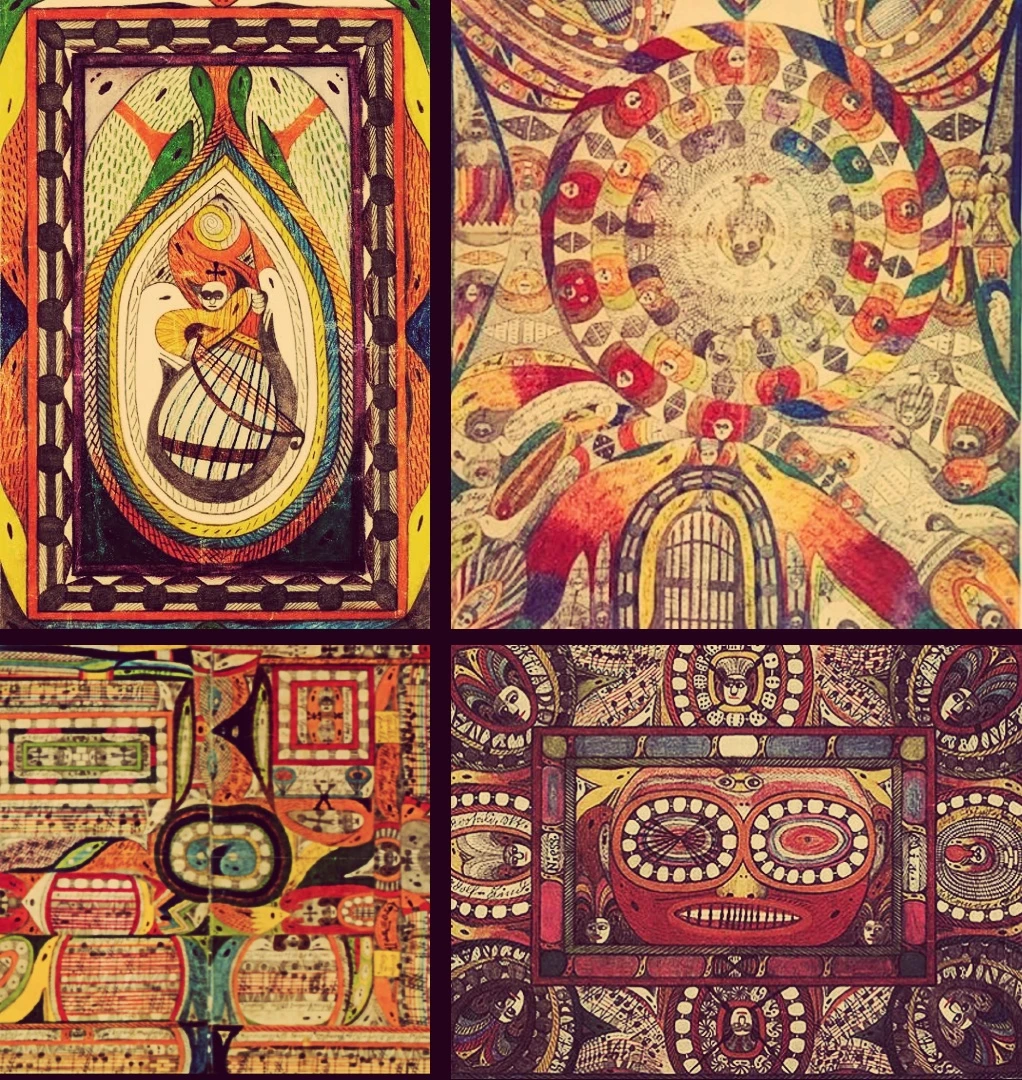
Maps as Talismans
Looking at Wölfli’s drawings, you might think you’re seeing maps, but maps of what? These aren’t geographic maps in the usual sense, but maps of a mental world: imagined cities, islands, palaces, cathedrals, talking plants, faces with blank stares, geometric lines, numbers, and scattered musical notes woven into the visual fabric of the artwork.
These aren’t images you simply see and forget, they seize your gaze. It’s as if the artist wants to prove his world is real through the sheer density of its details. Ordinary imagination is content with a single scene, but Wölfli’s imagination demands a complete archive: names, borders, maps, calculations, titles, music, and evidence. He doesn’t just imagine, he documents his fantasy as if he were the historian of a real civilization.
Wölfli isn’t the stereotype of the 'mad artist' painting at random. Instead, he’s a mind that has broken away from shared reality and tried to construct a new, highly organized one. This isn’t a total collapse of order, but the birth of a strange new system from within the breakdown.
The doctor who saw the artist, not just the patient
Adolf Wölfli’s work could have easily remained nothing more than odd sketches tucked away in a psychiatric file, if not for Dr. Walter Morgenthaler. Unlike most doctors of his time, Morgenthaler saw something different: not just symptoms, but genuine art worth studying. In 1921, he published a book about Wölfli titled "A Mental Patient as Artist," one of the first works to treat the creative output of a psychiatric patient as art in its own right, rather than just diagnostic material.
This marked a pivotal moment in both art and medical history. Wölfli’s work raised an uncomfortable question: could some creations from asylums be more authentic than the art found in museums? Is it possible for someone isolated, untrained, ill, and marginalized to produce art that challenges our very definitions of beauty and genius?
Later, French artist Jean Dubuffet would coin the term "Art Brut" , raw art , and make Wölfli one of its central figures. Art Brut refers to art created outside the boundaries of schools, markets, and institutions: the art of prisoners, patients, recluses, spiritualists, and outsiders. It’s untamed art, unconcerned with academic approval or mainstream acceptance.
In this sense, Wölfli was as raw as it gets. He didn’t draw to please galleries; he drew because he had to. For him, paper wasn’t just a space for expression, it was a necessity for survival.
Was he possessed?
From a folk perspective, Wölfli’s condition might seem close to the idea of possession. A man who hears and sees things differently, lives in isolation, writes obsessively, draws mysterious symbols, and invents a vast world ruled by strange names, numbers, and music. In another culture or era, people might have said he was possessed, haunted, or in touch with a hidden realm.
But modern understanding doesn’t need supernatural explanations to recognize how unusual his case was. Chronic mental illness alone can explain how perception detaches from shared reality, and how the mind can build a private world to make sense of fear, desire, guilt, isolation, and grandiosity. Still, Wölfli’s work is compelling because it doesn’t look like mere symptoms. It’s more organized than chaos would suggest, more intense than delirium, and more beautiful than pain alone could produce.
This is where the mystery lies: medicine can explain the mechanics, but it doesn’t erase the awe. Just as interpreting a dream doesn’t diminish its emotional impact, diagnosing a hallucination doesn’t stop us from marveling at the images it creates.
Art as a mask for the wound
Perhaps through his art, Wölfli was trying to regain control over a world he’d lost hold of since childhood. The boy without a home created continents. The poor laborer invented imaginary fortunes. The prisoner and patient gave himself imperial titles. Confined within the walls of an institution, he bought the world in his imagination and then reached for the universe.
This isn’t just artistic exaggeration; it’s a deep psychological mechanism. When reality becomes unbearable, the mind creates another one. Some people do this through dreams, others through myths, religion, madness, or art. Wölfli did almost all of it—on paper.
That’s why his work feels like a giant mask for a wound. But it’s not just a mask that hides; it also reveals. It exposes the need for recognition, for greatness, for purification, for rebirth. Each page seems to say, in its own way: I’m no longer that broken child, I am now the creator of an entire world.
Extraordinary imagination and the extraordinary mind
Does art require an unusual mind? Not always.
Many great works of art have come from stable, disciplined minds. But certain kinds of art—especially those that invent worlds unlike our own ,require an imagination that can pierce the ordinary surface of things. In Wölfli’s case, this imagination was tied to a mind that no longer lived within the usual boundaries of perception.
The problem is that this idea can be dangerous if romanticized: illness is not a blessing, and psychosis is not a shortcut to genius. Illness can crush, torment, isolate, and destroy lives. But when some patients manage to transform their turmoil into form, rhythm, language, and image, we witness something rare—not a celebration of illness, but a testament to the human ability to wrest meaning from the darkest places.
Wölfli didn’t create art "despite" his illness, nor solely "because of" it. Most likely, his art, his illness, and his harsh life were all fused together. We can’t separate the light from the dark. That’s what makes his story both fascinating and unsettling.
His Legacy: From Patient Files to the World’s Museums
After his death in 1930, his work didn’t disappear—quite the opposite. It began a new journey. Wölfli went from being a psychiatric patient to a central figure in the history of outsider art. His creations are now displayed in museums, studied in academic circles, and discussed in the fields of psychiatry, art history, and aesthetics.
He’s no longer just a 'case study.' Instead, he’s become an ongoing question: Where does illness end and art begin? Who gets to define beauty? Does art require conscious intent, or is it enough for it to leave an undeniable impact?
Wölfli’s power lies in forcing the world to look at a place it preferred to ignore: the psychiatric hospital. Behind those walls—where people assumed all reason was lost—a solitary man was building one of the most complex artistic projects of the twentieth century.
The World We Don’t See
Adolf Wölfli is not an easy figure to grasp. His story is filled with pain, guilt, illness, isolation, creativity, and an almost unbelievable imagination. He can’t be fully exonerated, nor can his life be reduced to his crimes.
He can’t be idolized as a genius, nor dismissed as simply 'insane.' He stands at that unsettling boundary between creativity and collapse, between vision and delirium, between art and illness.
Perhaps his entire world was a desperate attempt to repair a shattered sense of reality. Or maybe it’s proof that when the mind strays from what most people consider real, it doesn’t always fall into emptiness; sometimes, it lands in another world—private, frightening, ornate, filled with voices, maps, and little gods.
In Wölfli’s case, that world was made from cheap paper and pencils, yet it was vast enough to consume an entire life—and to keep puzzling us decades after his death.
Was Adolf Wölfli a patient drawing his madness? Or an artist who found, in his madness, a gateway to a universe we cannot see?
Maybe the answer lies somewhere in between: in that gray area where art begins when the ordinary mind can no longer explain itself.
About the Author