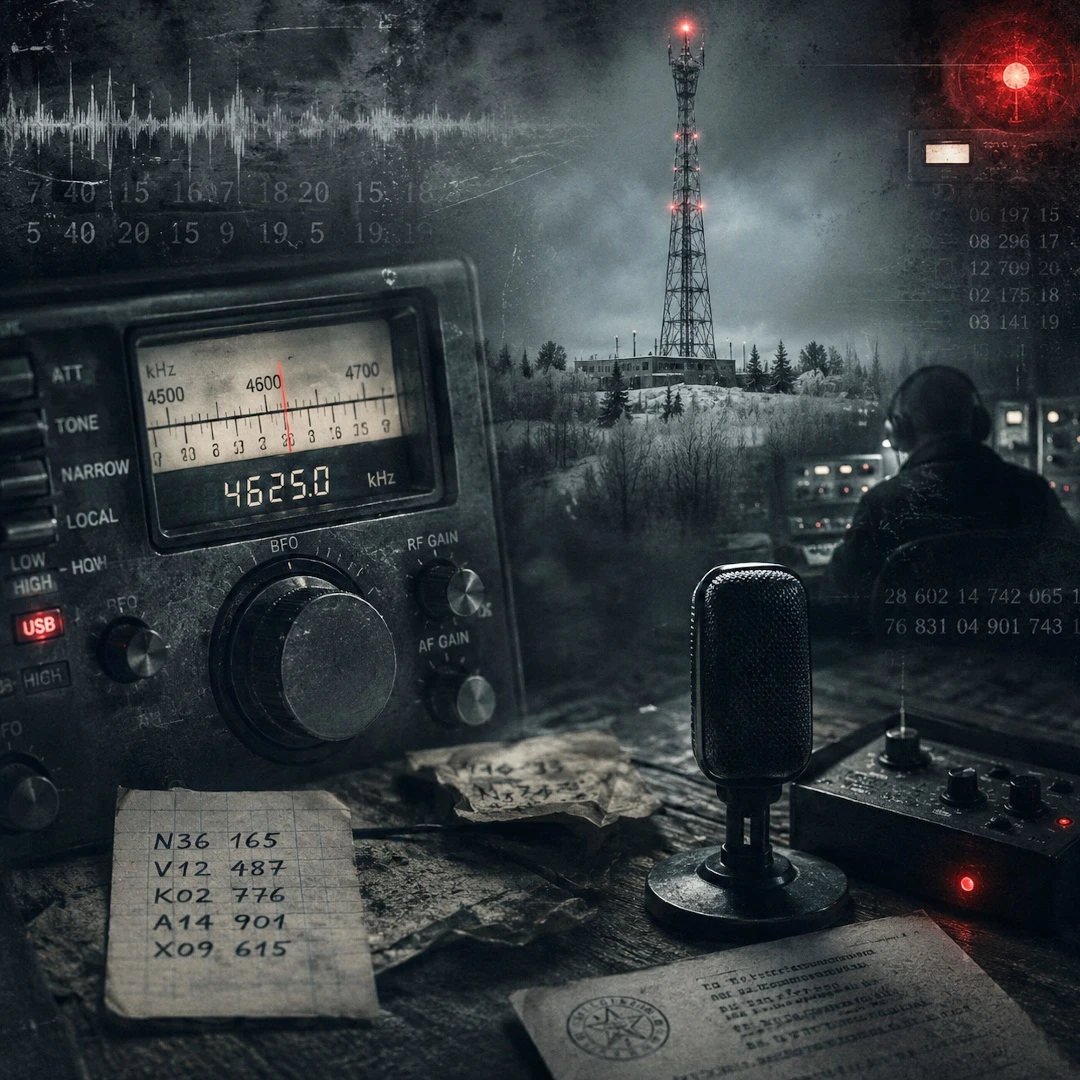
Tune in to 4625 kHz on the shortwave band, and you'll hear a strange signal coming from Russia: a mechanical, monotonous buzzing that repeats almost endlessly. There’s no music, no news, no station identification, just the drone. Occasionally, the buzzing cuts out and a man or woman reads out a string of Russian words, numbers, and letters, then the buzzing resumes.
This signal is known worldwide as UVB-76, or "The Buzzer." Over the decades, it’s become one of the most famous mysteries in military communications. Radio enthusiasts have recorded its messages, tracked its source, and tried to crack its code, but its true purpose remains unknown.
The most popular legend claims the buzzing isn’t just a communications signal, it’s the heartbeat of a Russian nuclear system. If it ever stops for good, it could mean Russian command has been destroyed and an automated nuclear retaliation will be triggered.
So, are we really listening to a "Doomsday Broadcast"?
A Station Without Programs
UVB-76 isn’t a radio station in the traditional sense. It’s widely believed to be part of a Russian military shortwave communications network. Even its famous name may be a misnomer: the original call sign was likely UZB-76, but UVB-76 caught on among Western observers and stuck in popular culture.
The call sign hasn’t always stayed the same. Over time, identifiers like MDZhB, ZhUOZ, and NZhTI have appeared, suggesting this isn’t a single, permanent station, but rather a network that changes its callsigns and structure over the years.
Reports of the signal date back to the Soviet era, with recordings known from at least the early 1980s. The Soviet Union collapsed and the Russian military was reorganized several times, but the signal kept going.
What happens when the buzzing stops?
Most of the time, the frequency just broadcasts its repetitive buzzing. But every so often, the sound stops and a human voice delivers a short message.
One of the most famous messages was recorded in 1997. It included the numbers 180 08, the code word BROMAL, and then 74 27 99 14. During the broadcast, the letters in BROMAL were spelled out phonetically to ensure accuracy. The word itself doesn’t mean anything known; it’s almost certainly a military code that only makes sense with a specific key or instruction set held by the intended recipient.
Radio hobbyists have managed to record and categorize these messages, but their meaning remains elusive. The reason is simple: if a word like BROMAL is just a code referring to a specific order in a secret military table, analyzing its literal meaning won’t help. The real recipient has the key or codebook; outsiders only have the encrypted text.
So, saying "the UVB-76 code has never been cracked" is only partly true. We know exactly what’s being said, but we don’t know what it means.
Why the constant buzzing?
The most widely accepted technical explanation is that the buzzing is a channel marker—a sound that keeps the frequency active and easily identifiable.
For a military unit waiting for orders, hearing the marker means their equipment is tuned correctly and the network is still up. When needed, the buzzing stops, the coded message is sent, and then the buzzing resumes.
This explanation removes much of the mystery: the buzzing itself probably doesn’t carry any secret message at all.
Shortwave radio still makes sense for military use, even in the age of satellites. These signals can travel long distances and don't rely on the internet or phone networks, making them valuable if modern infrastructure is jammed or destroyed during wartime.
It's not a problem if the enemy hears the messages as long as they don't have the key to decode them.
Human Voices Behind the Broadcast
One of the strangest things listeners have reported is hearing sounds that aren't coded messages: movement, knocks, distant whispers, and conversations, as if a microphone inside the communications site was accidentally left on.
In 2010, the phenomenon became even more noticeable. The buzzing signal was interrupted several times, unusual sounds and music clips appeared, and some of the network's call signs changed.
This coincided with a major reorganization in the Russian military, which supports a practical explanation: listeners were probably picking up the sounds of equipment being moved or a communications center being relocated, not some secret or paranormal event as speculated on internet forums.
The Abandoned Facility

For years, the signal was linked to the Povarovo area northwest of Moscow, where a military communications facility once operated. After activity at the site stopped, explorers entered and found buildings, equipment, and remnants related to communications. Photos of the abandoned location spread online, creating an intriguing paradox:
If UVB-76's source was abandoned, where is the buzzing that's still being heard coming from?
Stories quickly emerged about underground installations and secret mobile stations, but the most likely explanation is that Povarovo was just one part of the network, not its only source. After the Russian military's reorganization, transmission sites were moved or split among several facilities.
So, the story of the 'abandoned station' shifted from being evidence of a mysterious secret to a sign that we're dealing with a multi-site military network.
Is It a Spy Station?
One long-standing theory is that UVB-76 is one of the Numbers Stations used by intelligence agencies to send encrypted instructions to their agents.
The similarities are clear: shortwave frequencies, mysterious messages, numbers and words, and no official explanation.
Traditional numbers stations would appear at set times, broadcast a message, and then go silent. In contrast, UVB-76 keeps its frequency active most of the time with a continuous buzzing sound, making it seem more like a military command network than a station for a lone spy.
The Doomsday Radio Station
The most popular and sensational theory links UVB-76 to a Soviet nuclear system known as Perimeter, which became famous in the West as the Dead Hand.
Perimeter is not a myth, it was developed during the Cold War to ensure the ability to launch a nuclear response if Soviet leadership was wiped out.
But the legend added another twist: it was said that the UVB-76 buzz served as a signal confirming the leadership was still intact. If the buzzing ever stopped completely, the system would assume the command structure had been destroyed and trigger nuclear retaliation.
That’s how it earned the nickname 'Doomsday Radio Station.'
However, the evidence doesn’t support this story. The station has gone off the air several times due to technical issues, maintenance, or upgrades, with no consequences. It’s also unlikely that a strategic nuclear system would rely on a single high-frequency signal that could be jammed or interrupted for ordinary reasons. Most importantly, there’s no credible evidence directly linking UVB-76 to the Perimeter system.
While both Perimeter and UVB-76 are real, the connection between them remains an unproven legend.
Does increased messaging mean war is near?
Whenever the station’s activity spikes during a political or military crisis, rumors spread about the 'Doomsday Radio Station' waking up. Since it’s most likely a military network, it’s natural for usage to rise during drills, alerts, or operations. But there’s no way to know if any specific message is tied to a particular event, or if it’s just a routine test or exercise. So, while increased activity is interesting, it’s not a reliable indicator of war or nuclear readiness on its own.
Other theories
Over the years, some have suggested the station is used to communicate with nuclear submarines, test the atmosphere, or for electronic warfare. Theories have even stretched to mind control and contact with 'aliens.'
There’s no serious evidence for the more outlandish ideas. However, it’s possible the signal has additional military uses, like reserving the frequency, detecting jamming, or testing receiver readiness—all of which would fit with its main role as a communications network.
What do we actually know?
After decades of monitoring, the investigation can be summed up as follows:
Most likely: UVB-76 is part of a Russian military command and communications network. The buzzing keeps the channel active, while the voice messages carry encrypted orders for specific recipients.
Possible : May also serve additional functions, such as network testing, jamming detection, or frequency maintenance.
Less likely : Could be a numbers station used to communicate with a spy network.
Unproven : Claims of a link to the Perimeter system or that its shutdown would trigger a nuclear launch.
No evidence : Theories involving mind control, paranormal communication, or extraterrestrials.
The mystery that remains
Investigations have dispelled much of the myth surrounding UVB-76. Its source is no longer a complete mystery, there is strong evidence of its military nature, and the buzzing itself now has a largely logical explanation.
But one question remains unanswered: What do the messages mean?
Anyone with the right receiver can listen to the words and numbers broadcast by the network. We have decades of recordings, we know the message patterns, call signs, and some of the former transmission sites. The only thing missing is the key. That’s why UVB-76 remains unique: a military secret broadcast openly to the world, yet still locked to all but its intended recipients.
Somewhere within the Russian communications network, the buzzing stops for a moment. An unknown voice reads out a word and a few numbers, then falls silent.
And the frequency returns to its endless wait.
About the Author