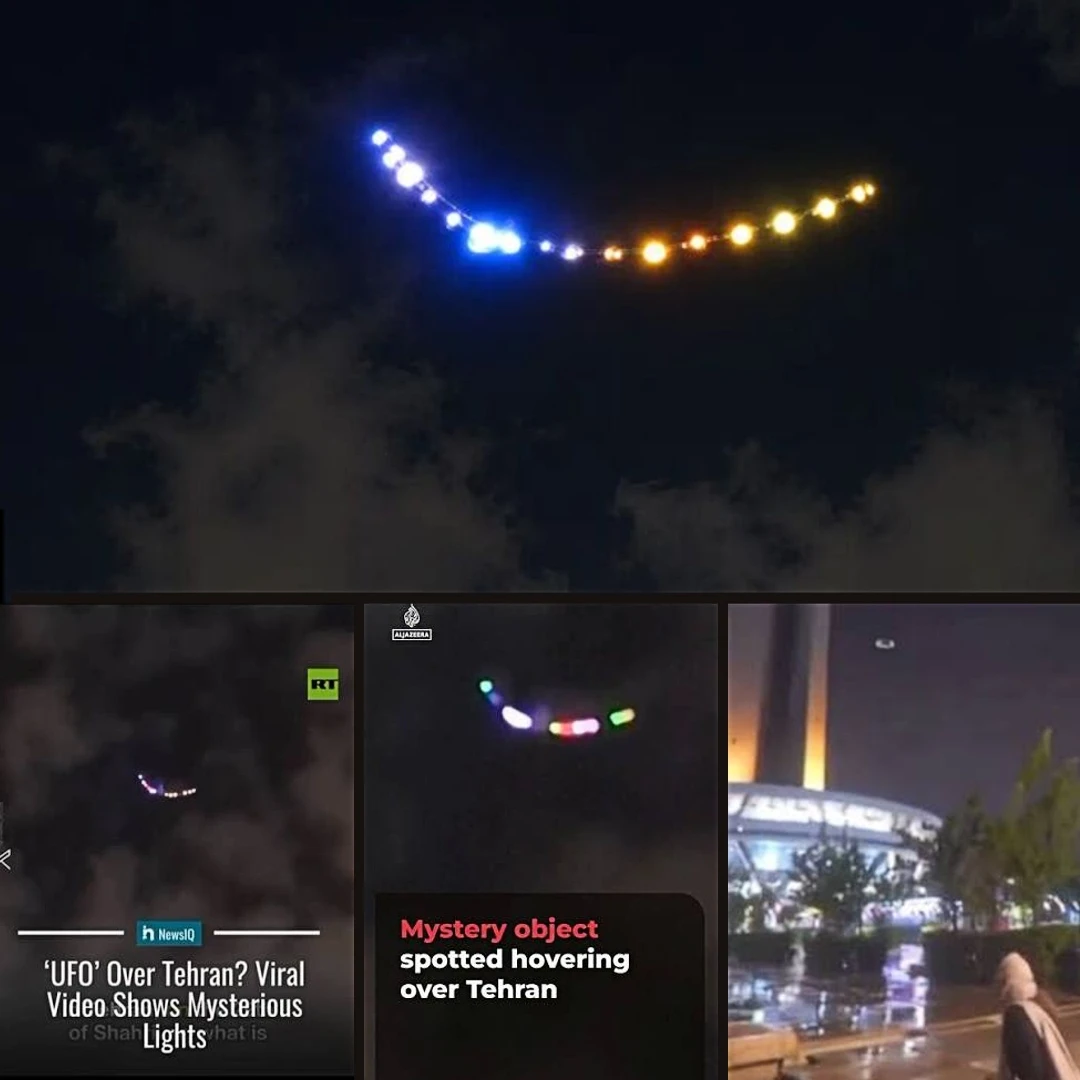
On the evening of September 20, 2026, someone was filming from a car driving along the Azadegan Highway south of Tehran when something unusual appeared in the sky: a series of colorful lights arranged in an arc, briefly looking like part of a large object suspended near the clouds.
The footage lasted only about 23 seconds, but that was enough to spark a wave of speculation online. Was it an airplane? A group of drones? Or an unidentified aerial object?
Adding to the intrigue, this sighting came nearly fifty years after one of Iran’s most famous UFO incidents, when military jets scrambled to intercept an unidentified object over Tehran in 1976.
But setting aside this striking coincidence, what does the new video actually show? Are we looking at a true unidentified aerial phenomenon (UAP), or do the details in the footage point to a simpler explanation?
Lights Suspended Over the City
According to information accompanying the video, it was filmed around 7:30 p.m. The footage shows a curved row of lights shifting colors between white, green, blue, red, purple, and orange.
The scene is striking because our eyes naturally connect the dots, mentally forming the outline of a single massive object, perhaps crescent-shaped or like a boomerang.
But here’s where things get interesting: when the video’s best frames are examined and enlarged, there’s no clear solid structure linking the lights. Instead, you see about 10 to 12 separate points of light, with dark gaps of sky between them.
This simple detail changes the nature of the whole case.
Was there ever a 'craft' at all?
The UAP Globe website analyzed the footage frame by frame, noting that the colors and arrangement of the lights are consistent with programmable LED lamps mounted on some kind of structure. This shifts the question: instead of trying to identify a massive craft carrying these lights, we first need to establish whether such a craft exists at all. The video doesn’t show any clear outline of a solid object, no surface reflecting light, and no structure connecting the illuminated points.
You can view the analysis and enlarged frames at UAP Globe’s analysis of the Tehran incident.
An Illuminated Kite?
After the video spread, an interesting comparison emerged with a type of kite equipped with LED lights, which can appear at night as a string of colorful lights hanging in the sky.
That UFO Podcast shared an example of a lit-up kite filmed in Bali, providing compelling evidence that a relatively simple object, when filmed from a distance at night, can produce an effect similar to what was seen over Tehran.
But similarity alone isn't definitive evidence.
The shape of the Bali kite doesn't exactly match the arrangement of the Tehran lights. No one has come forward to say they launched an illuminated kite in the area, and the object itself hasn't been found.
Still, this theory does account for several features of the sighting at once: the silence, limited movement, multicolored lights, and the absence of any clearly solid structure between them.
In fact, the arc formed by the lights seems to shift slightly during the recording, which would be more consistent with a flexible structure like a kite or a lit ribbon than with a large, rigid craft.
Could it have been a drone or a group of drones?
Another possibility is a drone equipped with LED lights, or several drones flying in a coordinated formation. Modern drone shows can already create geometric shapes and shifting colors in the sky, so there's no need to assume unknown technology to explain the scene. However, this theory faces the same issue: no drone operator has been identified, and there’s no close-up independent footage revealing their true nature.
More importantly, the video doesn't allow for an accurate measurement of the distance to the lights. Without knowing the distance, it's impossible to determine their size, speed, or altitude with any certainty.
This is a common mistake in analyzing UAP sightings: a small, nearby object can look huge and distant on video, and vice versa.
Were there multiple witnesses?
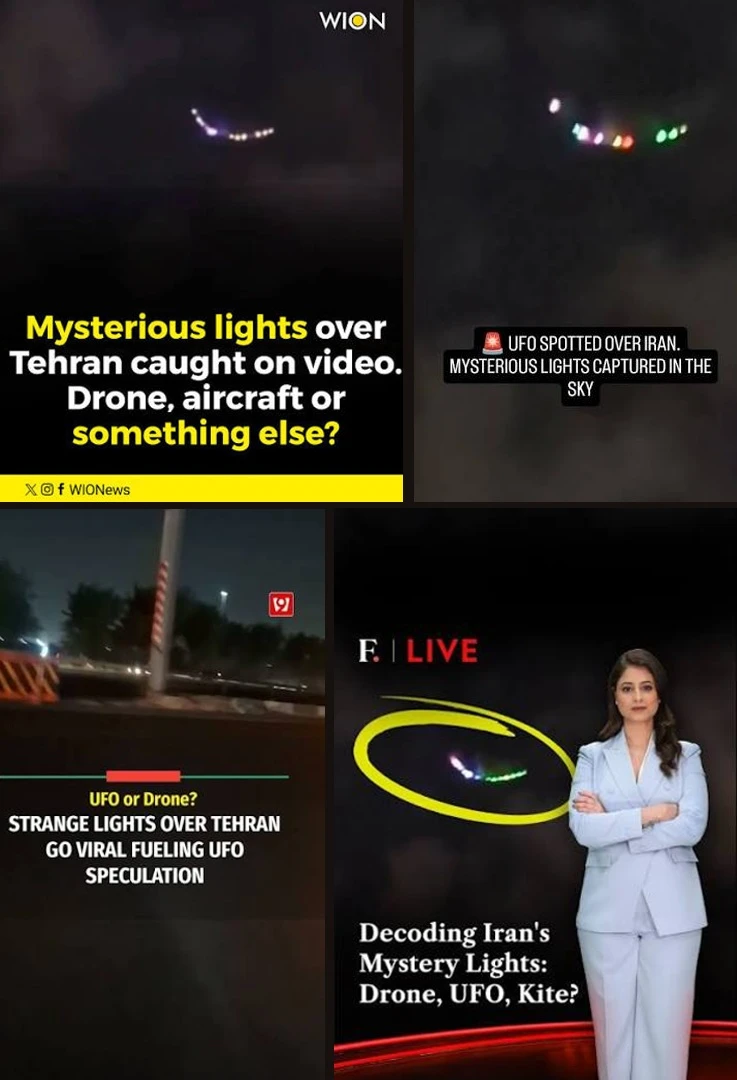
When the story spread, it was claimed that the object was seen and filmed from several different angles, which would have made the case much more significant. But a closer look at the available footage has cast doubt on that claim.
One of the clips presented as a second camera angle turned out to be the same footage reposted. Another low-quality video simply shows a distant light behind power lines, with no reliable way to confirm it's the same object.
At this point, there’s no clear, simultaneous footage from two different locations.
If such footage existed, the difference in viewing angles could be used to estimate the object's location, altitude, and size turning the case from a mysterious video into something that could be analyzed geometrically.
What about radar detection?
Some reports have circulated the dramatic claim that 'the object didn’t appear on radar,' but the reality is less definitive.
According to Iranian reports cited by Factnameh, the Iranian Civil Aviation Organization was contacted, and no known flight could be linked to the sighting.
This doesn’t mean that military or civilian radar systems confirmed the object’s absence, nor does it prove that something 'entered the airspace undetected.' No raw radar data has been released for independent analysis.
So the phrase 'didn’t appear on radar' overstates what the available evidence actually shows.
A coincidence that takes us back to 1976
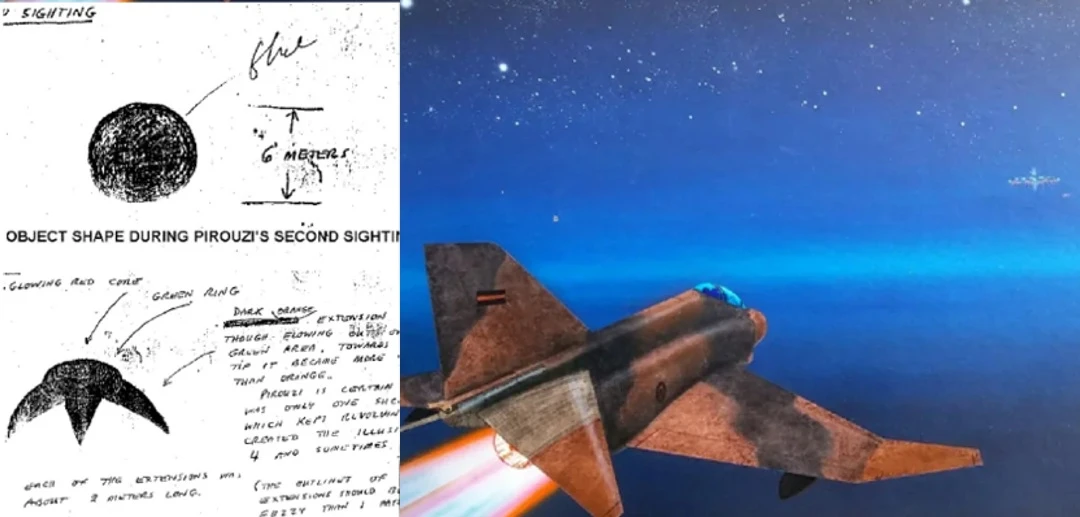
It’s hard to discuss an unidentified object over Tehran without recalling the famous September 1976 incident, when Iranian authorities received reports of a bright object in the sky and scrambled F-4 fighter jets to intercept it. That event later became one of the most well-known UFO cases involving both Iranian and American military reports.
That’s why the appearance of mysterious lights over Tehran nearly half a century later has a certain narrative appeal, but the similarities mostly end with the location and historical timing.
There’s no evidence connecting the 2026 incident to the one in 1976. The earlier case involved multiple witnesses, a military response, and official reports, while the recent event is based mainly on a brief civilian video.
Turning this chronological coincidence into a link between the two incidents would be a leap not supported by evidence.
What do UAP researchers say?
So far, none of the leading experts in UAP research have published a technical analysis that definitively identifies the object. However, specialized reviews of the footage agree on one key point: the video doesn’t show any confirmed extraordinary aerial characteristics.
There’s no sign of extreme acceleration, sudden changes in direction, instant disappearance, or speeds beyond what known aircraft can achieve.
There are also no published radar data or independent measurements of distance and altitude.
The UAP Globe analysis seriously considered illuminated kites, drones, and LED systems as possible explanations. Meanwhile, OSINT analyses suggested the filming location could be roughly identified from road signs, but found no clear evidence that the video was simply AI-generated.
This highlights an important distinction that often gets lost when discussing unidentified aerial phenomena:
Calling something a UAP simply means its identity hasn't been determined yet, it doesn't mean it's a spacecraft or non-human technology.
The most likely explanation
After reviewing the available evidence, the simplest explanation is a low-altitude local object equipped with LED lights—possibly an illuminated kite or a similar flexible platform. Drones also remain a reasonable possibility.
The changing colors, absence of a visible solid structure between the lights, limited movement, and slight variations in the arc shape can all be explained by these scenarios, without needing to assume unknown capabilities.
However, the word "possible" is key here, no illuminated kite has been found, no drone operator has come forward, and there’s no second verified camera angle or radar data to settle the matter.
For now, what appeared in the skies over Tehran remains unidentified in the literal sense.
Not because the footage proves something beyond known technology, but simply because the available data isn’t enough to confidently identify those points of light.
Perhaps the most intriguing lesson from this incident is that sometimes the real mystery isn’t what we see in the sky, but how our minds try to connect the dots and create an object whose existence was never actually confirmed.
About the Author