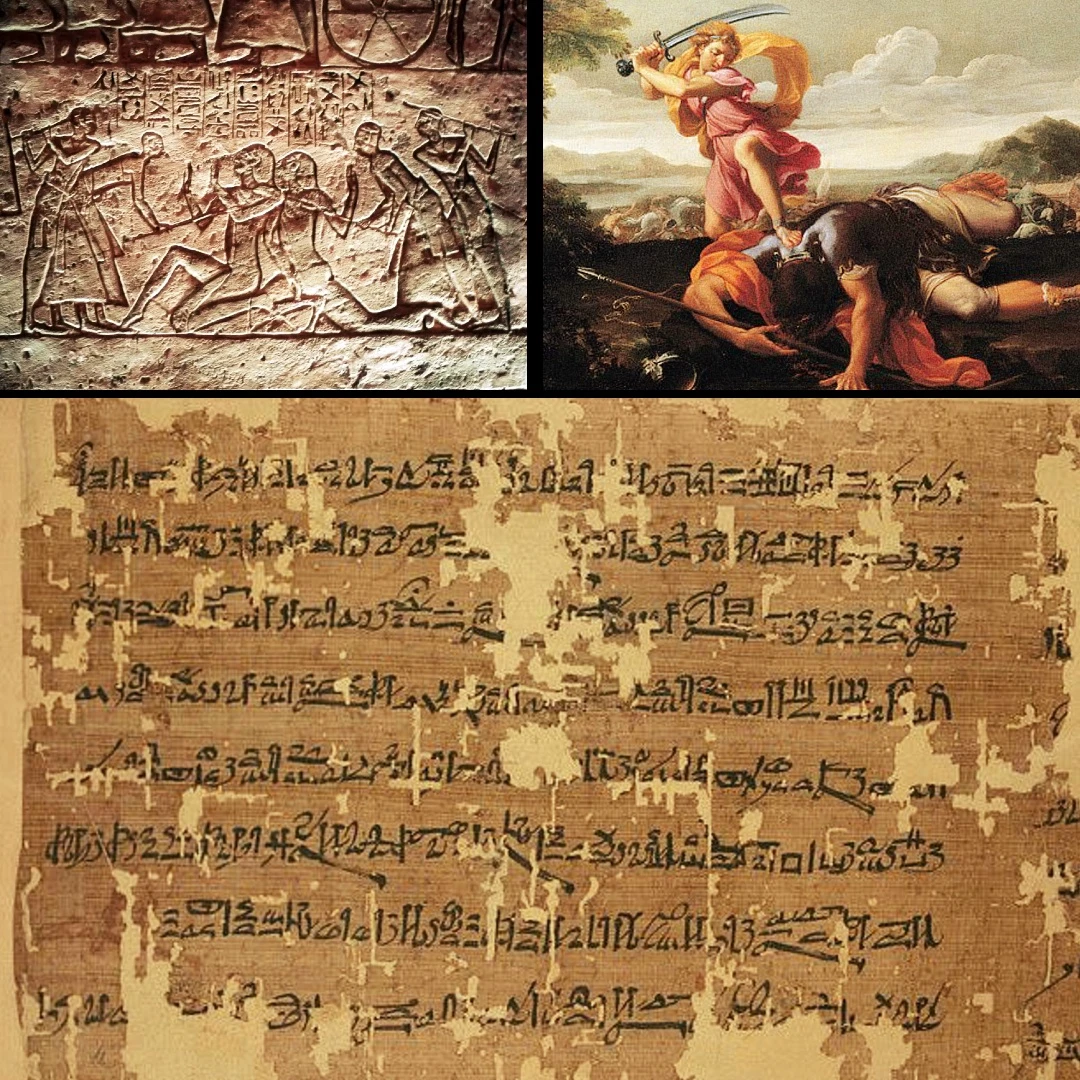
An ancient Egyptian papyrus preserved at the British Museum has reignited a longstanding debate about one of the most controversial stories in the Bible: Did giants really exist in the land of Canaan?
Known as the Anastasi I Papyrus, this document dates back to Egypt’s New Kingdom, specifically the 19th Dynasty, around 3,300 years ago. Written in hieratic script, it has been part of the British Museum’s collection since 1839, after being purchased from the antiquities dealer Giovanni Anastasi.
What makes this papyrus significant isn’t its religious content, but rather that it’s a satirical instructional letter exchanged between two Egyptian scribes. In it, the military scribe Hori criticizes another scribe, Amenemope, for his lack of knowledge about the geography, routes, and military dangers of the Levant and Canaan.
One particular passage has caught the attention of researchers interested in biblical archaeology. While describing a dangerous mountain pass, Hori warns of a group known as the Shasu nomadic or semi-nomadic people associated in Egyptian texts with the southern Levant. He describes some of them as being 'four or five cubits tall,' with fierce faces and unyielding hearts.
According to modern calculations, if the cubit referred to is the Egyptian royal cubit (about 52 centimeters), the height mentioned would be roughly between two and two and a half meters. This has led some scholars to suggest that the papyrus could be a non-biblical reference to exceptionally tall people in Canaan—the same region where the Old Testament mentions the 'Nephilim,' 'Anakim,' and 'Rephaim.'
In the Book of Genesis, the term Nephilim appears, a Hebrew word sometimes translated as 'giants' or 'fallen ones.' The Book of Numbers also recounts that Israelite spies saw people of great stature in Canaan, descendants of Anak, and described themselves as mere grasshoppers by comparison. The figure of Og, king of Bashan, is also mentioned as a remnant of the Rephaim, with a notable reference to his enormous iron bed.
Supporters of the giants hypothesis point to the Anastasi I Papyrus, along with other Egyptian texts such as the Execration Texts which mention a name similar to 'Anaq' and the Kadesh battle reliefs, which depict unusually large Shasu captives. They argue that these sources may reflect a historical memory of tall groups in the ancient Levant.
However, most academic experts take a more cautious view. The British Museum, for example, classifies the papyrus as satirical literature rather than a straightforward military report. Many scholars believe that describing ancient enemies as gigantic was a common rhetorical device, meant to exaggerate the threat or highlight the difficulty of a journey or the fierceness of an opponent—not to provide an anatomically accurate account.
The lack of physical evidence remains the biggest obstacle to any definitive conclusion. To date, there are no documented skeletons, oversized dwellings, or large-scale artifacts that would prove the existence of a 'race' of giants in Canaan or elsewhere. Even individuals over two meters tall, while rare in antiquity, do not necessarily indicate the presence of superhuman beings—they could simply represent exceptional cases among humans.
For this reason, the Anastasi I Papyrus does not prove that the biblical giants were historical figures as some imagine. Instead, it shows that the ancient Egyptians recorded or perhaps imagined the presence of tall and imposing warriors in the mountain passes of the Levant.
Caught between religious texts, military rhetoric, and popular memory, the papyrus remains an enigmatic witness to a region that, for thousands of years, has been a stage for wars, legends, and fears of the 'other' beyond the borders.
So were the Shasu truly tall men, or did the Egyptian scribe exaggerate their image to make the road to Canaan seem more terrifying?
The answer still hangs somewhere between ancient ink and the human imagination when confronted with the extraordinary.


