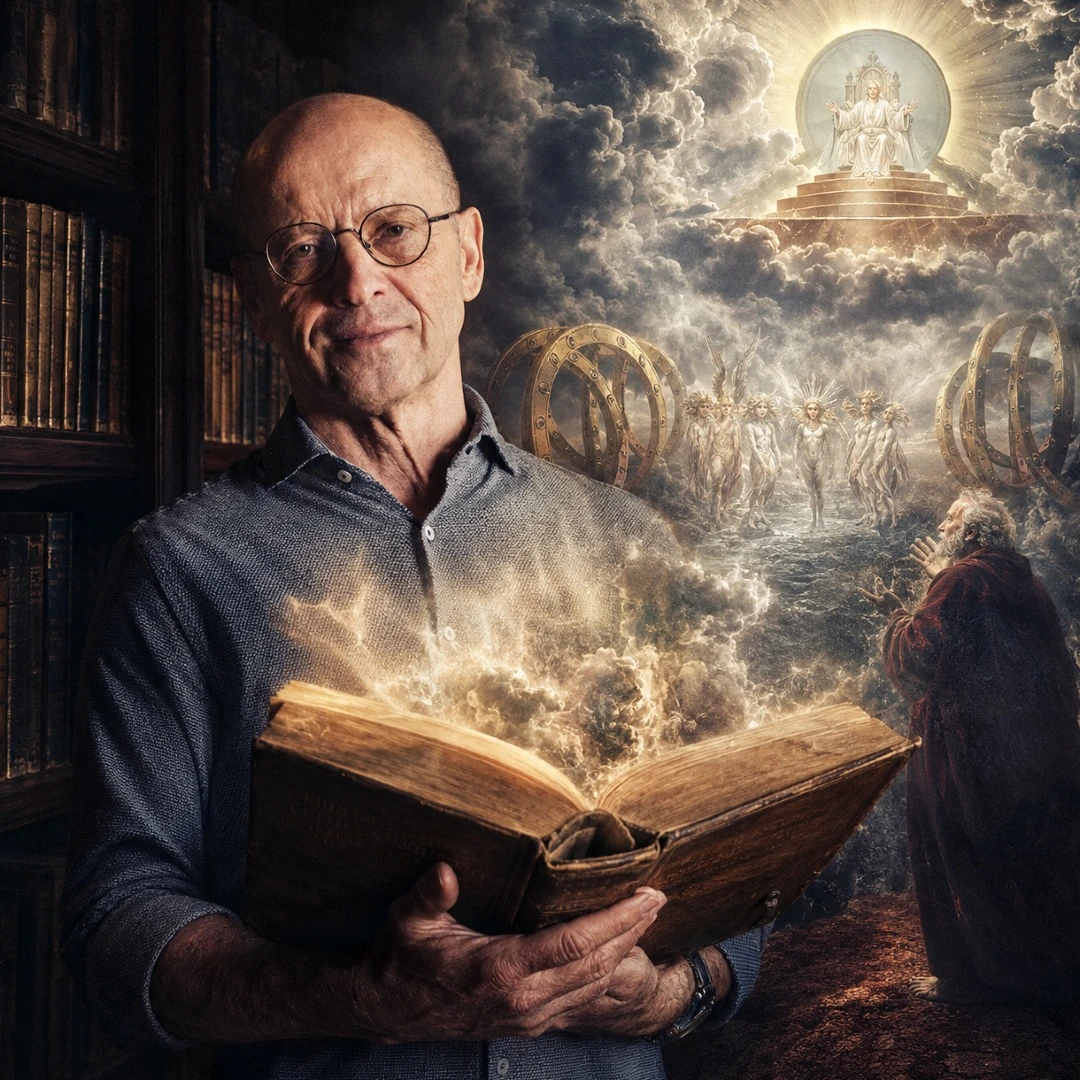
Italian researcher and translator Mauro Biglino has sparked fresh controversy with his claim that some original Hebrew texts in the Bible may not refer to a single God as traditionally interpreted, but rather to a group of powerful beings with advanced abilities and technology entities later understood as gods or celestial beings.
Biglino is a former translator who worked on biblical texts for Edizioni San Paolo, a well-known Catholic publishing house in Italy. He says that years spent working with the Hebrew text led him to adopt a perspective that diverges radically from traditional theological interpretations.
In an interview with the British newspaper Daily Mail, Biglino went further, claiming that sources he considers reliable told him that figures within the Vatican are following his work and discussing his ideas in certain theological circles.
Notably, Biglino has not provided independent evidence that the Vatican is monitoring him or preparing a response. He simply notes that, given the widespread reach of his books, some form of intervention from the Church could become possible in the future.
"Elohim": One God or a Group of Beings?
A significant part of Biglino's argument centers on the Hebrew word 'Elohim,' which is grammatically plural. He suggests that this plural form, along with passages describing councils or assemblies of divine beings, could indicate a group of independent entities rather than a single deity.
He also examines names and titles such as Yahweh, Elyon, and Shaddai, which Jewish and Christian traditions typically interpret as referring to the same God. Biglino questions whether these originally pointed to different powerful beings.
According to his reading, these figures do not always behave as all-knowing, omnipresent gods. Instead, he describes them as material rulers: moving from place to place, holding councils, dividing lands, engaging in conflicts, and governing different groups.
He adds that some texts attribute human-like actions and emotions to them, such as eating, drinking, resting, anger, and jealousy. He particularly cites Psalm 82, which describes a divine assembly and includes a line stating that some present "will die like men," suggesting they were not immortal or eternal beings.
He also references Deuteronomy 32, which depicts the division of nations among heavenly powers or beings. However, none of these texts mention extraterrestrials or civilizations from other planets. The most common academic and religious interpretation sees these figures as celestial beings or members of a 'divine council' subordinate to the God of Israel, not as alien visitors.
Additionally, while 'Elohim' is grammatically plural, it often appears in the Old Testament with singular verbs and attributes when referring to the God of Israel. Hebrew linguists consider this strong evidence that the plural form does not necessarily indicate multiple gods in those contexts.
Spaceships in Ezekiel's Vision?
Biglino is clearly aligned with the Ancient Astronaut Theory, which proposes that technologically advanced beings visited Earth in ancient times and were interpreted by early humans, within the limits of their understanding—as gods, angels, or demons.
One of the most frequently cited texts by proponents of this theory is the vision of the prophet Ezekiel, which describes wheels, fire, lights, strange creatures, and movement in the sky.
Biglino argues that some of these descriptions could be seen as primitive attempts to describe technology or flying machines for which ancient people had no suitable vocabulary.
Most biblical scholars, however, view Ezekiel's vision as religious symbolism and prophetic imagery. They argue that interpreting these images as technical blueprints for a spacecraft requires assumptions not supported by the text itself.
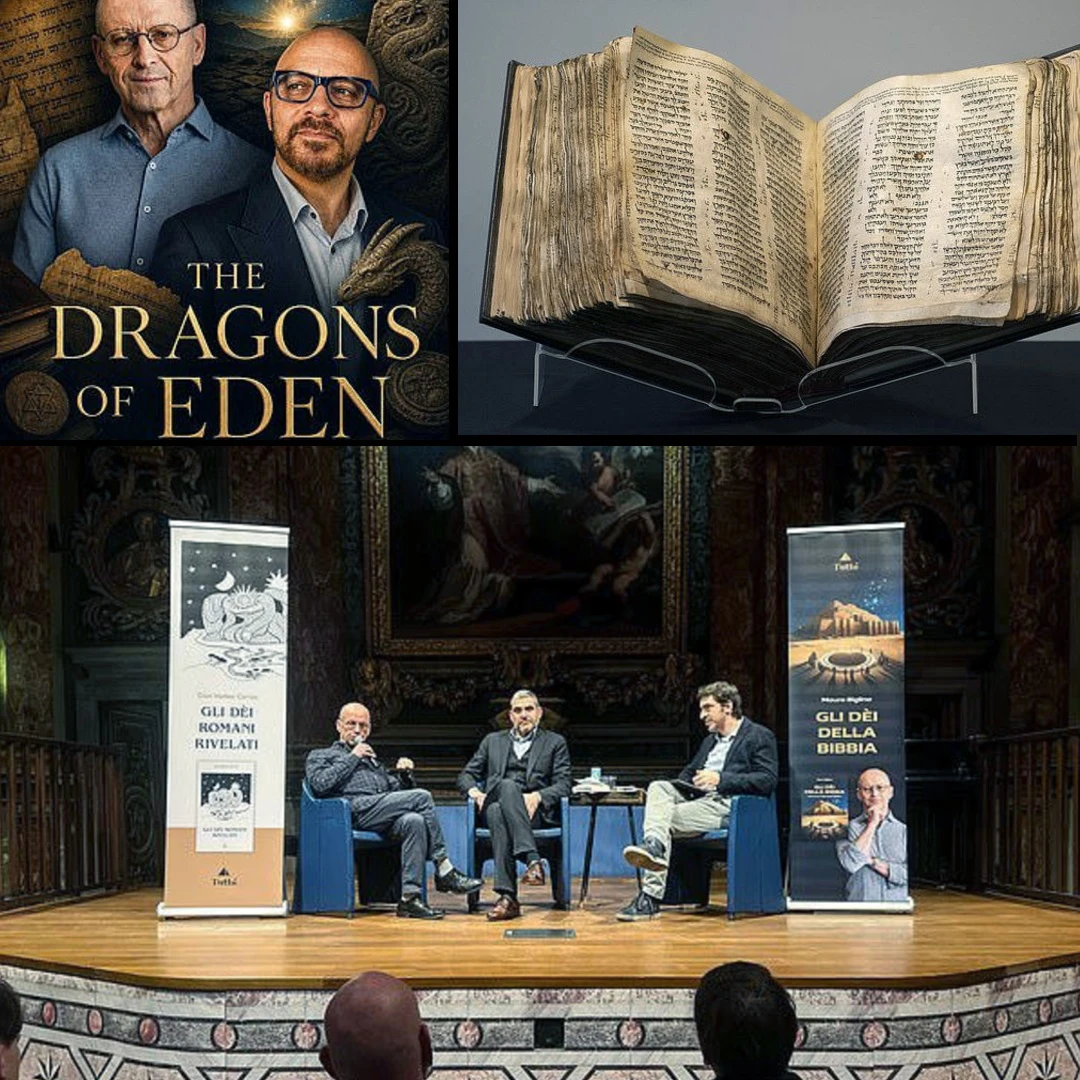
"The Glory of the Lord"... a Physical Machine?
Another term that Biglino focuses on is 'Kavod,' which is traditionally translated as 'glory' or 'majesty' of the Lord. Biglino points out that the Hebrew root also carries meanings of weight and heaviness. He argues that certain passages in Exodus and Ezekiel describe the Kavod as something that moves, arrives, departs, and is associated with noise, fire, and light and that it could pose a danger to anyone who comes too close.
This suggests that it may have been something physical, or even a technological device, rather than just a spiritual apparition. The idea is that ancient texts might preserve memories of people who had contact with beings possessing advanced knowledge, longer lifespans, and technologies that writers of the time could only describe using the language and concepts familiar to them.
However, moving from the idea of 'weight' or 'tangible presence' to the hypothesis of a spaceship isn't something the language itself demands, it's a result of interpreting the text through the lens of the ancient astronaut theory.
Does the Vatican know something?
Biglino believes that Vatican experts historians, archaeologists, and scientists must have discussed the possibility that ancient religious texts contain accounts of human contact with non-human intelligence. He distinguishes between two scenarios in this context.
In his view, the discovery of microbial life or even an intelligent civilization on a distant planet wouldn't pose a major theological problem; the Church could simply consider these beings as another part of creation.
But discovering that non-human entities actually came to Earth in the past, interacted with humans, and were later worshipped as gods would be far more disruptive to some traditional religious beliefs.
Over the years, scientists and staff connected to the Vatican Observatory have openly discussed the possibility of life elsewhere in the universe. However, this doesn't mean the Vatican accepts the ancient astronaut theory or possesses secret evidence to support it.
An intriguing interpretation isn't proof
The appeal of Biglino's theory lies in its ability to reinterpret familiar texts in a new light, raising a provocative question: What if ancient people described something technological using the language of gods, heavens, and fire?
The problem arises when this question is treated as a definitive answer. The presence of ambiguous words, descriptions of fiery objects in the sky, or gatherings of divine beings doesn't automatically prove visitors from other planets. For the 'ancient astronaut' hypothesis to be taken seriously as a historical theory, it needs independent, testable evidence: inexplicable technological artifacts from the era, materials of extraterrestrial origin directly linked to an ancient civilization, or corroborating documents that don't rely solely on reinterpreting metaphors and myths.
So far, no such evidence has come to light.
Why I reject the 'ancient astronaut' theory
While I find these hypotheses fascinating to explore and debate, I don't consider the ancient astronaut theory credible enough to explain the origins of religions, myths, or ancient civilizations.
The main problem with this theory is that it often starts with the conclusion it wants to reach, then searches through texts, images, and artifacts for anything that might fit. If there's 'light in the sky,' it's called a spacecraft; if a 'god descends from the heavens,' it's labeled an astronaut; if an ancient structure shows advanced engineering, it's attributed to an alien civilization.
By this logic, almost any myth can be turned into a story of alien contact.
This approach also tends, unintentionally, to underestimate the ingenuity of ancient people themselves. Pyramids, temples, astronomy, engineering, and mythology don't necessarily require teachers from the stars; they were the result of human societies with thousands of years of accumulated experience, observation, and knowledge.
Rejecting the 'ancient astronaut' theory doesn't mean ruling out the possibility of intelligent life elsewhere in the universe, the two issues are entirely separate.
The universe may well be full of life, and there could be civilizations millions of years older than ours. But claiming that one of them visited Sumer, Egypt, or ancient Palestine and was later worshipped as gods requires much stronger evidence than a vague text or an ambiguous inscription.
That's why I remain open to the question, but so far, I see the 'ancient astronauts' theory as an intriguing hypothesis that reinterprets history, yet still lacks the physical evidence needed to turn it from a possible story into historical fact.


