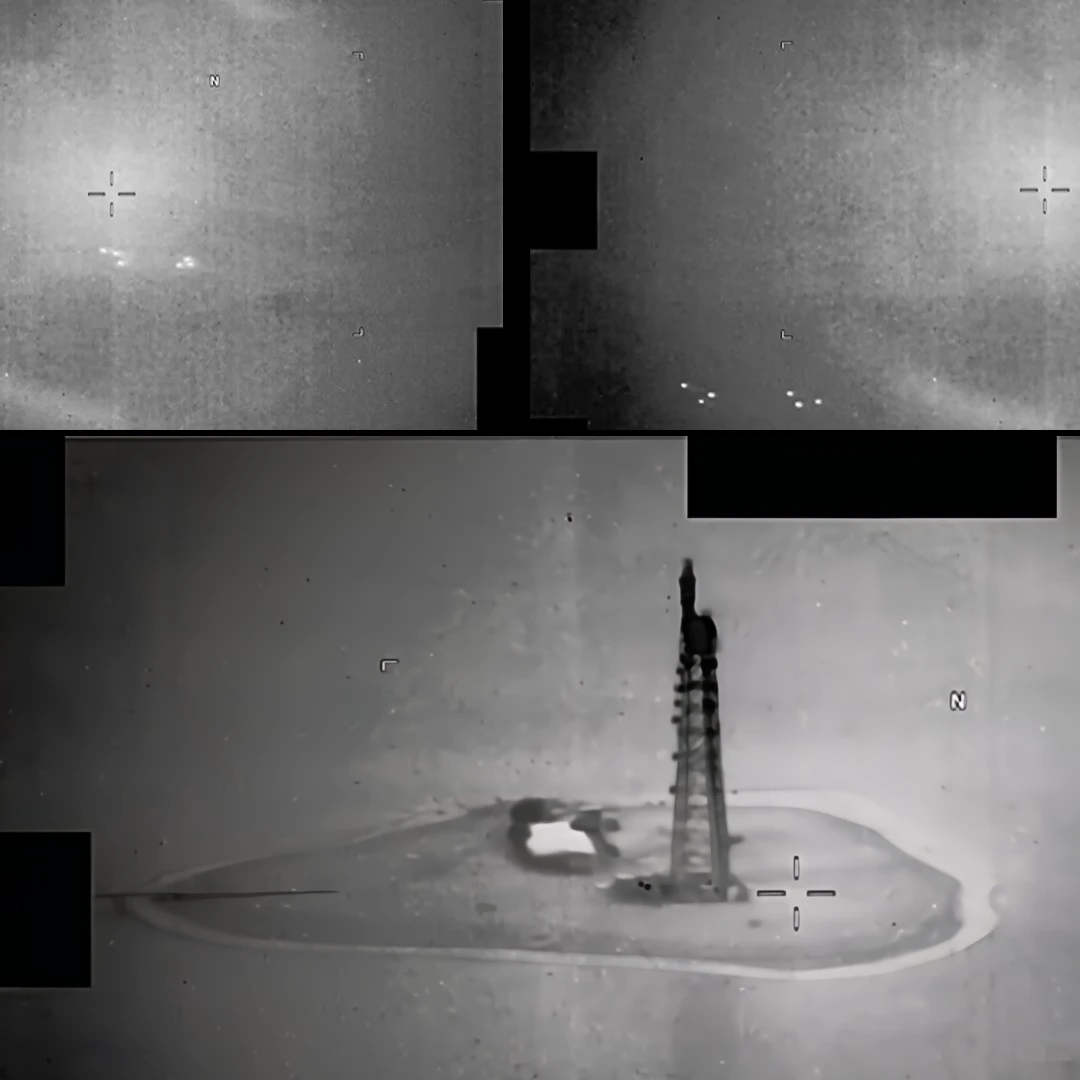
In the latest batch of declassified U.S. military documents, a mysterious incident over an undisclosed location in the Middle East has come to light. A military crew observed six small spherical objects moving together and changing direction in ways that caught the attention of their monitors. The incident wasn't just documented in writing; it was also captured on infrared video by a U.S. military platform. The official report left the identity of these objects unresolved.
The incident was released as part of Release 6, the sixth set of materials published through the Department of Defense's PURSUE program. This program makes declassified reports and materials related to UAP (Unidentified Anomalous Phenomena) incidents available to the public.
The event took place on July 29, 2025, during an aerial mission linked to Operation Inherent Resolve under U.S. Central Command (USCENTCOM). However, details only became public after the report was declassified on July 10, 2026, and subsequently published on September 18 as part of a new release of UAP files.
The report, labeled DOW-UAP-D108, was originally classified as 'SECRET/NOFORN' (secret and not for foreign distribution). The document reveals that the first contact with the objects was recorded at 20:22 UTC. Many details, including the exact location and the type of military platform involved, remain redacted.
Six spheres moving together
The report clearly describes the objects as six small spheres grouped together. The observer noted that they moved nimbly and frequently changed direction.
What stands out even more is that the report's 'anomalous behavior or characteristics' section states the objects were observed to change direction rapidly and simultaneously.
Their speed was estimated at about 480 miles per hour (roughly 770 kilometers per hour) at an altitude of FL220, or about 22,000 feet (6,700 meters). The objects were moving southeast, while the military platform was heading northwest at a recorded speed of 120 knots. The report classified the physical state of the objects as 'solid.'
However, these figures should be treated with caution. The document itself notes that the speed, altitude, and trajectory are estimates. It also states that no independent interrogation or sensor confirmation of the targets was conducted, meaning the 480 mph figure should not be considered a precise radar measurement.
One-minute thermal video
Alongside the report, the military released a video labeled DOW-UAP-PR135, recorded by an infrared sensor aboard a U.S. military platform.
The video is about 59 seconds long. According to the official description, between the fifth and tenth seconds, several distinct areas move across the sensor's field of view from the top of the frame to the bottom. From seconds 11 to 47, the sensor tracks these areas, trying to keep them near the center of the frame, before the zoom level is changed in the final seconds.
This highlights an important difference between what the report describes and what the video alone shows.
The footage clearly shows targets or areas of contrast being tracked by the sensor, but this alone isn't enough to prove the objects were moving at 480 miles per hour or performing extraordinary maneuvers. In fact, the publisher of the video included a clear disclaimer, warning viewers not to treat the accompanying description as an analytical judgment or a conclusion about the reality, nature, or significance of the phenomenon.
Were they under intelligent control?
The report doesn't provide an answer. In the section asking whether the objects were under 'intelligent control,' the response is 'unknown.' The means of propulsion also remain unidentified, as do any radio frequencies. The report notes no effects on personnel or equipment, and no materials or objects linked to the incident were found.
The report also marks 'NO' for advanced capabilities or materials. This is significant, because labeling the phenomenon as a UAP doesn't automatically mean the military considered it a craft with unknown technology or non-human origin.
What could they be?
Based solely on the available video, it's difficult to determine the nature of the objects. Conventional explanations—such as balloons, small drones, or other objects that appear unusual due to the angle of observation or the movement of the platform and sensor—are possible, but the published information isn't sufficient to confirm any of these theories.
On the other hand, the report describes six spherical objects moving as a group and changing direction rapidly and in sync. If the observer's assessment of their movement is accurate, that's precisely what makes the incident noteworthy.
There's another issue: the location itself is classified. The released documents don't specify the country where the incident occurred, only referring to the area as the 'Middle East.' The coordinates and other operational details have been withheld.
Between the unknown and premature conclusions
What makes this case significant is that it's not based on an anonymous video or an unverified online account. Instead, it comes from an official military mission report and sensor recording. U.S. Central Command referred the incident to the All-domain Anomaly Resolution Office (AARO) as an unidentified aerial phenomenon.
But 'unidentified' is the key word here. The document doesn't claim the objects are spacecraft, nor does it prove they possess technology that defies the laws of flight. There are no independent measurements confirming the reported speed or maneuvers. At the same time, the released file hasn't provided a definitive conventional explanation for what the crew and sensors observed.
So the six spheres remain in that gray area that makes UFO cases so intriguing: there's enough documentation not to ignore the event, but not enough to truly understand what happened.
Were these just ordinary objects that appeared strange due to observation conditions and sensor movement? Or did the military crew actually witness a group of objects performing an unusual synchronized maneuver?
So far, neither the previous classified report nor the thermal video provides a definitive answer.
About the Author